Showing posts with label oxford story tree. Show all posts

Monday, 2 February 2026

On Thin Ice - the graded reader (not the state of Greenland)

Reading for detail - Read & Imagine
As you can easily see, there's a lot of text on the page, which most learners in Japan would baulk at immediately!

Our 'can do' learners at Luna have got used to this psychological barrier & can jump it with ease.

  • Quiet reading? Yes
  • Reading independently (at home)? Yes
  • Overcome 'new' words? Yes
  • Familiar with characters? Yes
  • Enjoy the storylines? Yes
  • Recycle language? Yes
  • Personalisation with 'after reading' projects? Yes
  • Work together with comprehension tasks? Yes
  • Gain confidence with pronunciation of longer words? Yes
  • Notice direct speech markers (punctuation)? Yes
  • Read ahead for markers? Yes
  • Look back in the story to refresh? Yes
  • Travel in time & space, around the world? Yes
  • Learn really cool stuff? Yes
  • Put proper intonation into longer utterances (taking turns 'in character')? Yes
  • Listening skills explored? Yes
  • Gain confidence spelling? Yes
  • Volume of vocabulary? Yes
  • Expanding vocabulary sets beyond limited textbook content? Yes
  • Yes.Yes. Yes.
There are so many benefits to our dedication at Luna to incorporating graded readers into our students' language learning careers. One of them is our adoption of Oxford's Read and Imagine + Read and Discover series - designed for young language learners with audio and activity books to enhance the learner experience. In our opinion, Oxford's Reading Tree is not fit for purpose, and the Extensive Reading Foundation's continued idolisation of that culturally loaded & unsuitable series is frankly annoying - driven by 'experts' who lecture from their high perches at universities without any idea what they're talking about wrt young learners, accessibility, learning styles, affordability. You never saw Oxford's Story Tree, which WAS ideal for the EFL classroom & independent home-readers?

Rant over? Not really!

Friday, 31 July 2015

Planting acorns - Luna's Reading Tree

Current progress
Back in April, to coincide with the start of  a new academic year here in Japan, we endeavoured on yet another project: Luna's Reading Tree. As our students develop their reading skills, we wanted a reminder within the classroom of their progress as means of evaluation for both student and teacher. Conveniently, it also adds to the decor!

As part of our reading curriculum, the Oxford Story Tree series has been a staple to many of our young learners as their first steps to reading in English and beyond. Having only become acquainted with Kipper and the gang relatively recently, I've thoroughly enjoyed their grand, and at times bizarre, adventures alongside my students.

The first step
Part of the reason this series has been such a hit with Luna is the language progression, each story builds on the vocabulary from the previous titles to allow students to expand their vocabulary without getting heavily bogged down with too many new words. Each series also comes with an audio CD, to listen in class or at home, and a workbook focusing on the key words from the story. Both bring a great wealth of additional materials/content for children to internalize the language.

The entire series spans 7 levels, with each level represented by a different colour, while at Luna we use the first four levels: red blue, green and orange. We believe this provides enough of a platform for our students to begin discovering their own titles and genres to explore.

The secret room looking lonely
Luna's Reading Tree represents all 28 titles, in the forms of leaves, from the 4 series, differentiated by the different colours. Each time you complete the story along with the workbook, you add a customised acorn to the relevant "leaf" to show off your accomplishments. Our goal is to have a luscious tree budding with vibrant energy, although our initial plan may not come to complete fruition as the Oxford Story Tree series are no longer available to order in Japan.

Never fear though as we still have some tricks up our sleeves and an opportunity to discover other fascinating stories to spark our students' imaginations.

Wednesday, 30 May 2012

Exploiting graded readers with a simple board game

Browsing reader to add vocabulary to game board
I think the most battered & dog-eared photocopiable resource I have on the shelf here at Luna is Heinemann Children's Games by Maria Toth - back in the day teacher's resource books were few and far between (and expensive!)

Mining text for words
Recently I wanted to find a 'new' way to exploit the reading books our children are very engaged with. Or were. Once we have 'finished' one, we seldom have the time to go back and wander through the stories again. The series we like (OUP Story Tree) does a very good job of recycling language, but I wanted to do a bit more. This is how.

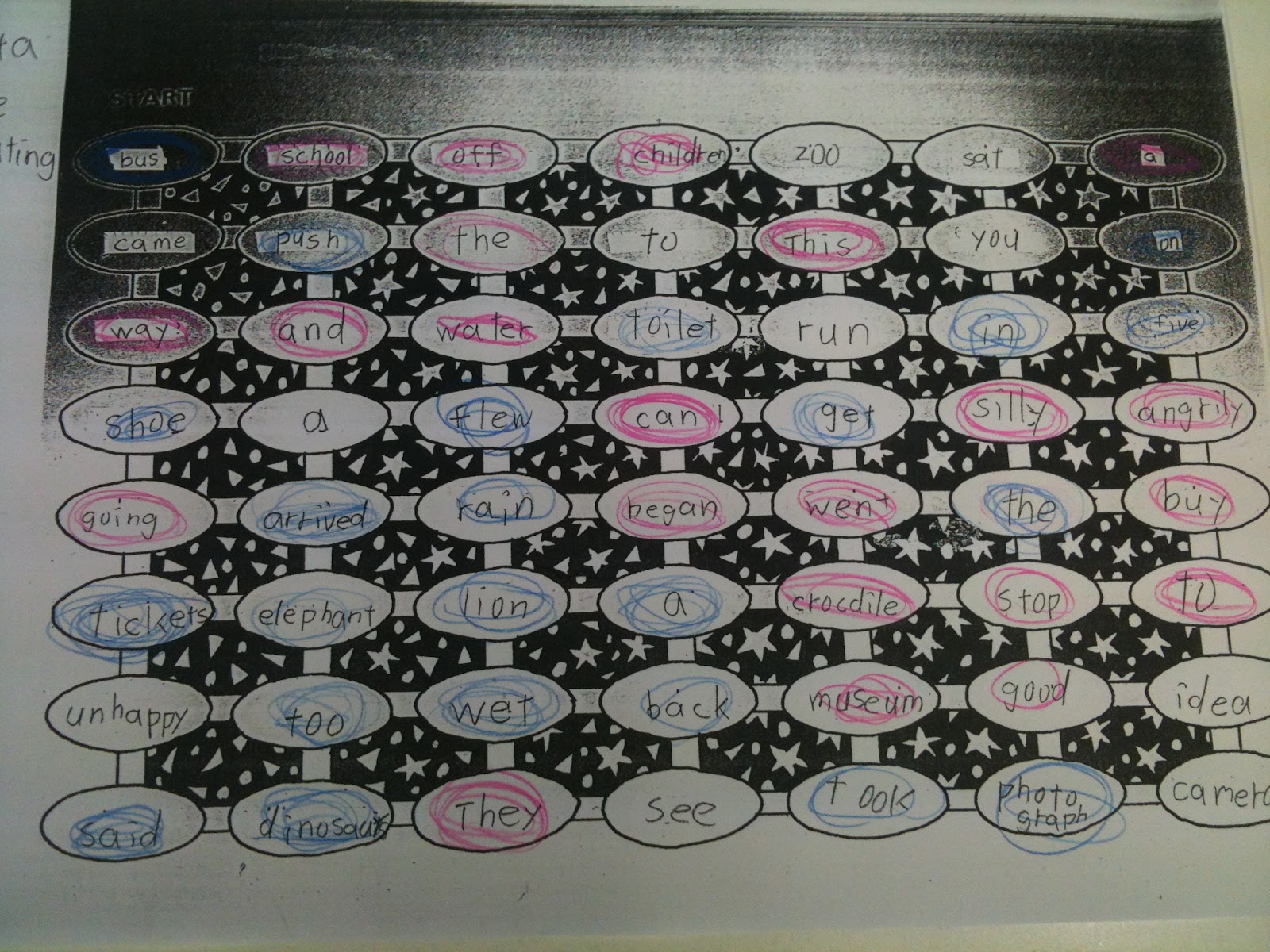
The game grid is 8 x 7. Each locus/circle on the grid is connected horizontally & vertically by a line, which is the direction of travel players are allowed. In each circle contains a word. Two players take turns to throw a dice, and move their marker around the board. Each move, they circle the word on the board with a colour pencil (ie 2 different colours for the two players) and write the word down on another peice of paper/notebook. The other player cannot pass through a circle which is not their colour. The aim is to collect words to make a sentence.

Making the game - a race itself
Simple - but not so simple as you might think! Students are not just copying...Let me explain the mechanics.

The teacher's oldest friend tippex = blank board. Ask each student in the class to choose a different book. This is an ideal exercise for end of series or term, and once the students know what to do, could be easy homework. Students are asked to leaf through their reader, and pick out words to put onto their board - anywhere they like. NB To make the game 'work', you will need to make sure there a couple of words repeated in there eg 'a', 'the', 'to'...otherwise one player will bag the key word(s) and the other player is snookered!

Playing the game
Apart from the above proviso, let students rip into their readers. Some will want to add the 'hard' words, others their favourites. Whatever! Try to avoid duplicates. Do this in pencil, just in case you need to tweek in a couple of words to facillitate actual sentences. For example, singular and plural nouns make a nice variety. One of my students decided to use only the shortest words (it, is, a, yes, no). OK...but the other students refused to play his game. Peer review is a teachers' secret weapon :)

As each student has used a different book, you will have a quick stock of games. Write the name of the book on the board - and photocopy them. Push the boat out & laminate if you want to save for those rainy days when half the class doesn't turn up!

Initially, students will play and collect random words. Sooner or later, the penny will drop that they will need a strategy. Subliminally, this means students will want to be keenly aware of collocates eg I've got "went", but I can't make a sentence with it unless I also have "to". One of my teens started muttering grammar words to herself ("shugo, shugo. Ah, dai-meishi") - she was hunting for a subject and settled for a pronoun. Cool!

Game board - end of play
As students build a list from the board, they may need a nudge to get started cobbling together sentences - some will feel they need to reconstruct a sentence from their story, for example. Once an example or two are scribbled down, students will see how, where & what they can substitute to make new sentences with the same (limited) vocabulary they have acquired - and see what else they want to grab. Word order awareness? adjective + noun combinations? verb + adverb?  third person 's' on verbs or not? Without an agenda, this sweetlygives an alert teacher micro-teaching moments.

The winner might be the first student to create a whole sentence...but why not milk the exercise for all it's worth? Give a point for each word in a sentence. Bigger scores for embellishment! These were examples from a recent game (source vocab = Orange Story Tree "The Outing"):
My scribbles
  • A crocodile went to the school.
  • Children went to the school.
  • Children went to the crocodile.
  • A crocodile went to the toilet angrily.
  • Silly children buy a crocodile.
  • A silly crocodile went to the museum.
By the end of a game/lesson, students will have re-read their reader once, if not several times (can't remember what words mean, go back & find them in context), and written them down at least three times. They will have deconstructed the text & rebuilt with meaning - I'm not steeped in theory but that is a lot of grammatical & lexical processing going on (voluntarilly - I've got to win!)

Let's read some more!
Try this at home/in your reading class. Can't claim ownership of the idea (back to Maria Toth). My students have loved this (and viewed it is a game ie not proper class)...and begged to do again.

Hmm. Have to read more books then, won't we!



Wednesday, 8 September 2010

Run & Spell


I've always loved doing running dictation and today was no exception. We'd spent some time on "The Dragon" already, reading the book itself and doing various activities around the book. And this was the ultimate test - a spelling test with a didifference. Yes, you can look at the words in the book, but the book has to be in a different room and you cannot bring the book back with you and just copy it down. Worked a treat! The students were able to remember (most of the time) and got all the spelling right when we checked at the end. I also asked them to point at various words on their page once we'd finished to check if they could recogonise words by sight, and was very pleased to see them working it out for themselves. For example what's the difference between "dragon" and "dolphin". A whole lot as I'm sure you'll agree!

Monday, 8 March 2010

ABC waiting time

I found my smart Monday evening girls amusing themselves cleverly - spelling their names and other words they 'know' on our large carpet mats. Good for them! I despair of how little advantage is taken of the resources we have available for children & parents in the school.
  • We used to leave a PC for free use - never touched.
  • We left our games out on a shelf - thrown around, bent out of shape & broken
  • BBC TV, Discovery Channel etc left on for free - volume muted
  • Streamed BBC & Virgin radio (as was) into the school - asked to turn it off
Erm. As a school I think we have to be an oasis of English, and any opportunity to get more exposure likely to be welcomed. I think. "Silly daddy", Eleanor likes to say.Maybe she's right.

Anyway, I was delighted to see my super polite and hard-working crew challenging each other to spell stuff, including new words from their Story Tree readers, set for homework last week. Who cares if they had to double-check?! Excellent application & lateral thinking.


Reblog this post [with Zemanta]

Wednesday, 11 November 2009

By the stream

Mum is by the stream.

Kipper's teddy sits on the rug.

A frog is in the stream.

Three children are on the bridge. They drop sticks in the water.

Toru (10)