Showing posts with label Education. Show all posts

Saturday, 29 November 2025

Postcard from...Dazaifu Tenmangu, Fukuoka, Japan


I was unable to visit this 1,100 year old shrine in northern Kyushu before, so I made it a priority 'stop' for my next visit to the region. Daziafu Tenmangu is on every parent's bucket list for their teenage childrens' futures!

I was fortunate enough to have a spare couple of hours on my way to an examining gig last week to make the detour, and explore this famous complex. I was not alone - several thousand Chinese tourists had the same intentions, thought they didn't get there on a local bus from Hakata station (Fukuoka International airport is only half an hour away from the shrine).

I posted an album of photos from my visit on Flickr - please take a look & leave a 'like' or a comment!


Tuesday, 21 June 2022

Life of country people before WW2

Before WW2, Japan was unequal society. The urban people had convenience life, but the country people’s life was not easy. Most of the country people had no running water and gas, and water drawing was daily hard work. The half of population was engaged in agriculture, but the lands suited to agriculture were limited in Japan. The half of farmers had their own lands, but another half rent the lands. It was quite hard to rent the lands because they could not harvest well due to unseasonable weather and natural disaster. In 1930’, some of country people sold their daughter into prostitution to rend the lands, and it was social problem.

Before WW2, women could not get same chance for education as men. After graduating elementary school, most of women had no chance for further education and only wealthy women could go to an upper secondary school, but it was school to learn sewing etc. to dutiful wife and devoted mother. Up to WW2 was over, a good wife and wise mother was the ideal image of a woman in Japan. In 1913, 3 women joined Tohoku university for the first time. I would like to thank various innovative step and hard challenge which people in Japan before WW2 took to improve life and chance for education.


Thursday, 4 February 2021

Lessons available - rugby schooling, education fail

I'm a rugby fan through and through, and an English rugby fan to the core (despite Scottish, Welsh, Irish, Ulster & various other ancestral claims)...let's go with British? But I'd really like to still be European (but not French).

Anyway, I was watching this https://youtu.be/_t012MeQFqw about England's preparations for the upcoming Six Nations (which I'm really excited about), when it struck me watching the team doctor, Dr. Richard Tingay....

Why the hell isn't this level of care, prevention, testing, tracing, preparation, training, awareness, glorification & celebration given to our teachers globally? I mean, there are about 40 players in the England squad, plus staff. That would equal your average class load at a school or uni - anywhere. Where's the priority?

Something very peverse is afoot. NOT blaming rugby AT ALL - rather, the fact that this kind of vital (and available/deliverable) attention to detail/data is totally AWOL in education. Imagine teachers swabbed daily with results same day? Etcetera and on.

Thoughts?


Monday, 30 November 2015

My first International JALT Conference

English Central with Charles Browne
I had the great privilege of attending the International JALT Conference in Shizuoka from November 20-23. Nothing could have prepared me for a hectic weekend filled to the brim with presentations, workshops, talking to publishers, networking, hands on learning, sharing ideas, socializing and this list goes on. It was such an amazing opportunity to be surrounded by fellow peers, soaking in the wealth of knowledge and experience available. The weekend changed my outlook on the kind of educator I aspire to be, and armed me with the tools in order to succeed.

I have never attended a conference of this scale before, over 1800 attendants over the course of 4 days, from all sorts of teaching backgrounds. There is so much to see and do, people to meet that there doesn’t seem to be enough time for everything. There were many presentations and workshops I missed out on due to clashes or being preoccupied with something else.  My mind didn’t even have to chance to wander as there was always something that required my full attention.

A huge crowd gathers for Paul Nation
The theme of the conference was: Focus on the Learner, perhaps something that can be, but never should, be overlooked. A lot of the presentations I attended had an emphasis on the importance of needs analysis; who are the stakeholders and what do they want? Are we truly fulfilling our role as a teacher if we fail to meet this single requirement?

With needs analysis also comes the task of identifying problems and solving them: what is not working, why not and how to go about fixing it. Not every problem has a simple solution and you have to be equipped with the suitable knowledge and tools. A major point to keep in mind when it comes to self evaluation and expanding your teaching skills, something I will be keeping at the forefront when it comes to lesson planning.

Publicity Officers' meeting
Another thing that often cropped up, which is something I find myself guilty of at times, is the
teacher taking a step back and doing nothing. Let students do the work and let them figure out for themselves. The less time the teacher spends talking the better. I’m sure all my students would agree! I have a tendency to offer assistance prematurely and it is something that I need to work and improve on.

It was fascinating to get a glimpse of educators from across the globe sharing their insights, ideas and experiences. There was so much to take in that I was furiously scribbling in my notebook the entire time. I came away from the whole experience with a better understanding of how to cater to my student’s needs, my own pitfalls and weaknesses plus a host of ideas and techniques to implement in my classroom.

Research  results on show at a Poster Session
But it wasn’t all sunshine and rainbows, I had to share a hotel room with Jim after all! One of the main grumps was that Shizuoka did not lend itself to a good “after-event”. There was a lack of venues to continue the conference into the evening in a much more social manner, gathering ideas together over a couple of beverages and exchanging personal experiences. I guess you cannot have your cake and eat it too.

But in no way did that take anything away from my first International JALT conference. I feel as though I have come a long way since my first day on the job, but this conference has made me realize I still have a long way to go. I am looking forward to every single step of that journey. A massive thank you to all the organizers of the event, the staff involved and everyone who contributed to such a fantastic event.


A special mention to Jim for driving me all the way to and from Shizuoka, (even though I was a lousy navigator!), and introducing me to so many brilliant people. I cannot wait for the next one!

Thursday, 8 January 2015

About my school - an informative poster

Remi has been covering the topic of school and education, learning a lot about different education systems in place all around the world. I asked Remi what she enjoys about the high school she attends, probably an unfathomable concept for many students, and why she would encourage other high schoolers to study there. To get the word out, or at the very least attempt to convince me, about how awesome Remi’s school is, we set about making an informative poster through Glogster.

I gave Remi all the necessary tools for her project to make her poster as informative, appealing and fun as she saw fit. She even added photos of some of her school events, which was a nice touch. I must confess though that I would have liked to have seen a much more eye catching poster with a bit of snazzy editing. Also including her school’s name may have been useful.

Please tell us what you think as Remi would love to hear your feedback. Would you think about attending or sending your kids there? I think the 8 exams a year would throw me off!

Thursday, 24 July 2014

Cambridge English Teacher Scholarship Application

Mug shot of the (rather hopeful) winner
Recently Jim brought to my attention about the Cambridge English Teaching Framework and the Cambridge English Teacher Scholarship, which I can apply for by submitting an outline of where I believe I lie on the framework as well as how I intend to progress in each category. This doubles as a chance to reflect on my progress and future development plans as well as an possibility of winning a free trip to the 49th Annual International IATEFL Conference and Exhibition in Manchester next year. Fingers crossed I can win with my entry! (I may be in trouble with Jim if I don't!) Do you think I have a chance? Feedback and thoughts are, as always, more than welcome. 


As an English teacher who is still in the early stages of my career, I know that there are many aspects of my teaching that can be developed and built upon. In order to achieve this, it’s important to have realistic and challenging goals with a plan to bring these goals to fruition. Teaching ability is not necessarily quantifiable, but using the Cambridge English Teaching Framework as a reference allows you come to terms with your own skill level whilst providing a positive platform for further development.
 Having had a chance to read through the framework and do some well needed reflection, I find myself positioned somewhere between the “foundation” and “developing” categories. I am still at a stage where I am aware of and understand various techniques, methodologies, assessment principles etc when it comes to teaching, but I am not necessarily able to translate these concepts into my lessons effectively nor consistently.
Moreover, I currently have a tendency to concentrate more of my efforts on expanding my repertoire of teaching activities and resources rather than focusing on my weaknesses or adjustments that are required in my approach to teaching. Furthermore, as I gain in teaching experience, and in turn confidence, I appreciate more than ever that I cannot neglect the importance of my own professional development.
Taking a step back from my day to day position as an important member of staff at a small language school, I have realised that with the bigger picture in mind, I really do need to benchmark my progress and motivate myself beyond “developing”. Now, you may be wondering: “How do you intend to progress through the framework whilst achieving your career goals?” Good question!
I have found that a fantastic way of advancing personal development and finding new innovative ideas is by sharing experiences with other teachers. I am rather fortunate in having an enthusiastic and experienced long term English teacher as my mentor, as well as being fortunate enough to have been encouraged to attend a number of EFL seminars, workshops and training courses (such as the IIEEC Teacher Training Program) already. Through continued interactions with as diverse assortment of educators and instructors as possible, I believe that my open-minded and enthusiastic approach, along with my work situation, will grant me to put learning into practice quickly.
In addition, I intend to re-visit and critique past lesson plans in order to identify my strengths and weaknesses so I may adjust my teaching style accordingly. Deliberating over these points will enable me to enhance my development in the “teaching, learning and assessment” category, by identifying the most effective teaching methods and key concepts to apply within the classroom, and at the same time expanding myself in the “professional development and values” category by analyzing my flaws.

All in all I hope that I can start to achieve my full teaching potential through a combination of factors with the Cambridge English Teaching Framework acting as a solid reference point and as a bridge to my future development.

Monday, 14 July 2014

Workshop No. 4: Getting Maximum Results in Reading While Speaking

        My second in the series of reports I have written after completing the IIECT Teacher Training Program in Tokyo run by Ritsuko Nakata. As always feedback and comments are welcome. This workshop was presented by Naoko Saito & Junko Nakamura, entitled: Getting Maximum Results in Reading While Speaking

        The primal focus of the second workshop was how to develop the reading capability of young learners, an integral part of many young learners’ curriculum. Learning to read is no easy task, especially if you’re limited to 1 hour (or less) classes once per week, hence the significant importance of building a solid foundation by learning the English alphabet, the building blocks to becoming an accomplished reader, and their relation to sounds (or better known as phonics). From the alphabet we can build onto phonics and then progressing onto words and eventually sentences. If there is no foundation everything we build around it will crumble and fall, so it’s very important to get the basic right so learners don’t fall into bad habits early on. It’s also important to note that the students should know the meaning of the words and produce them orally before they attempt reading them. However, even just teaching the basic phonics sounds can be arduous and time consuming. This lead to the development of “MAT Phonics” so that students are able to, so they told us, learn all the sounds of the alphabet in just a few lessons. We were also told that in order to accomplish this successfully the students must already know how to say the alphabet correctly.
            The “MAT Phonics” method begins by teaching the vowel sounds in conjunctions with “MAT Vowel Actions”, these gestures helps young learners remember the short vowel sounds by replicating the shape formed by the mouth when saying these sounds. Next comes the consonant sounds. The consonants are split into four sound groups: “ee”, “e”, “ei” and “Mixed”. Once the consonants are split into their respective groups we implement something called “Phonics Math”, where we subtract the common group sound from the letter sound. For example the letter “b” belongs in the “ee” group and by applying “Phonics Math” we remove the “ee” sound to achieve the “b” phonic sound. Finally we have built our solid foundation and can move onto reading words and sentences by using these phonics sounds alongside some essential key words, some of which cannot be read phonetically (also referred to as sight words) that the students should already know such as; I, you, he, her, they, this, that, yes, no etc.
            Unfortunately I have had neither the time nor the opportunity to fully integrate these methods into my lessons. I have a habit on concentrating too much time on oral communication and not enough time on reading and writing, which is an aspect of my teaching that I want and need to change for the benefit of my students. On the other hand I have tried some of the suggested activities from the workshop, such as cutting up letters to piece together again and tracing the letters of the alphabet in the air with our eyes closed. I am very interested using the “Phonics Math” method but I am slightly weary that the concept may be a bit too difficult to grasp for some of the students. I guess there is only one way to find out.
            Although I did find this workshop useful and insightful, I am still slightly apprehensive about including more time to cover reading and writing skills during lessons. It’s something the students need to be exposed to on a regular basis so that they can progress, but I am fearful that there are not enough minutes in each lesson to cover everything satisfactorily. The MAT method mixes reading and speaking at the same time, and I believe this is the tact I must take to achieve a balance of reading and writing activities within my lesson plans. It is not enough just relying on the textbooks and workbooks as sources for reading and writing practice, I must diverge more from what I have become accustomed to by including supplementary reading resources such as the Oxford Reading Tree series or the Oxford graded readers.

Tuesday, 8 July 2014

Workshop No.3: Know Yourself, Know Your Students

Over June and July I have participated in the IIEEC-Oxford University Press Teacher Training Certificate Program in Tokyo run by Ritsuko Nakata. For each workshop attended their is an additional task of writing a report. Even though I am not intending to apply for the certificates, as I have no plans of attending all 6 workshops, I thought I would give them a go anyway. Any feedback or comments are very welcome.
Here is the first instalment of the workshop reports: Know Yourself, Know Your Students presented by Miki Sakai.

The focal point of this workshop was the “Multiple Intelligences” (also referred to as MIs, which is something I learnt about whilst completing my TEFL course), understanding the details of the different intelligences and how to apply them effectively within the classroom when teaching young learners. Everybody is said to possess each and every type of the 8 intelligences, albeit in different proportions. Unfortunately, especially in my case, just possessing these MIs does not necessarily make you intelligent. However by understanding the 8 intelligences, we are able to identify our students’ skillset to create appropriate lesson plans that coincide with their learning strengths by catering to their strongest intelligences. For example, a person who possesses strong “Math Logic” (or “Number and Reasoning Smart”) will be better suited to activities involving counting or logical thought, whereas someone who is “Bodily-Kinesthetic” (or “Body Smart”) is more geared towards activities which comprise of gestures and bodily movement. By combining as many of the intelligences as possible during our lessons, we are able to improve our students’ aptitudes for learning English.
It is interesting to note that each of the intelligences can be trained or developed, much like any other skill, meaning we can turn any weakness into strength. Or at the very least develop it to a point where it is no longer considered to be a weakness. The MIs also interact with each other, often in complex ways; they are not so black and white.  Students may be accomplished in many of the intelligences and may respond better to tasks that integrate various skillsets rather than focusing on them individually. People can be intelligent in many different ways and we can come to realize this fact through the MIs.
Even before attending this workshop I have always made a point of having variety in my classroom by trying new fun and invigorating activities as often as possible. Sure it’s great to have a little structure and routine as well, but as we all know young learners can be quick to lose interest in repetitive activities, which can lead to a dull and mundane classroom environment. Having attended the workshop, I now understand the importance of respecting my students’ proficiency in the different intelligences, not just the intelligences I am most comfortable and familiar with, in order to incorporate activities that focus on my students’ capabilities as well as providing flexible lesson plans that utilizes the MIs that the students are most skilled with whilst also developing their weaker intelligences.
Now comes the important part, applying what I have learnt from the workshop into my classroom. From previous experiences I have found that a majority of students tend to be visual learners, meaning that many of my classes include activities that revolve around the “Spatial” intelligence. I like to use props and items of realia as visual aids where possible in place of flashcards and promote associating gestures with words or phrases, even if some may not seem all that conventional. Students respond much better when presented with a visual stimulus when introducing new vocabulary, whilst the gestures can serve as prompts for when the students are unable to recall a word or phrase. I have also found that at times students are able to remember the gesture associated with the word instead of the word itself, although this doesn’t mean they have learnt and memorized the words completely I still view this as progress nonetheless.
Songs and chats are also a fantastic way of involving many of the MIs at once, it also gets the students motivated and energised whilst allowing them to express themselves with their bodies. There are such a multitude of songs to choose from it’s sometimes hard to decide what to use! I tend to go with songs that allow the students to express their individual creativity while interacting interpersonally with their peers. One of my favourite songs to perform is “5 little monkeys” from Knock Knock English. It combines the “Verbal Linguistic”, “Math Logic”,  “Bodily-Kinesthetic”, “Musical”, “Interpersonal” and (to a lesser extent) “Naturalist” intelligences in just 1 activity. There is even a video version available on the “Super Simple Songs” YouTube channel that would then additionally include the “Spatial” intelligence. This song also gives me the opportunity to work on my monkey impression, which always gets a great reaction from my students. Some of my students probably think it’s TOO realistic.

All in all I found this workshop constructive and beneficial towards my personal development as an English teacher, especially for young learners. As well as learning about the MIs in more detail than I had previously, the workshop gave me the opportunity to be exposed to new ideas and teaching techniques which I will be adding to my ever growing repertoire.

Saturday, 4 February 2012

Is the (Japanese) education system fit for purpose?

I came across this wonderfully articulate opinion piece (by Ken Robinson) as animated by RSA Animate. I liked the animation so much I immediately got the app for my phone (RSA Vision) and subscribed to their YouTube channel. Plenty to keep me awake this evening while I wait for the rugby to start at 2am!

education
education (Photo credit: Sean MacEntee)
I have been thinking quite a lot lately at how poorly education here (Japan) does by the children. For example, the most respected JHS in my town is actually rather rubbish (I should know, I picked up a part-time wage there from time to time over five years) and that when asked, teachers don't really have a clue where the children are at, educationally. This stark admission is criminal, in my opinion.

I think school here is geared to do several things, such as round off square pegs so they'll fit in the salaryman round hole & produce obedient fembots...but education is not very high on the agenda. I recently saw a friend raging on Facebook about dross homework & woeful assignments being submitted at his university. I recognised his purple-faced indignation immediately, from my own experiences at a university not far away. Long story short, would that level of work be rewarded anywhere else? No, of course not - so why is it the norm here? Because that's the way the system is set up. It is a self-reinforcing banality, and I believe a busted flush.

I see no signs of innovation at the schools I teach at. Quite the opposite - ostrich phenomenon. When my daughter was smaller, she would stand hiding facing a wall - hilarious, yes, but that is what the Japanese education system is still doing. "If we don't look around, no-one can see us"...and we'll still get our nice salaries and bumper bonuses. I don't see any evidence of innovation, invention, investment at the schools I visit - and I do not see the end result - drongo high school kids/1st year uni students - being any more ready for the real world than they were in the late 90s.

A case in point , which supports one example highlighted by Ken Robinson = the production line that is school intake. I must teach nearly a dozen 'returnees' at Luna, whose English skills are off the chart (relative to their non-immersed classmates). They are obliged to sit through English classes at school regardless. My idea? Round them up and engage a unique resource before it withers. As they are, they are picked on by the teacher to provide inane answers or model reading/pronunciation, which hardly ingratiates them with their peers. That English classes still feature predominantly L1 delivery (certainly in my experience) only adds to the futility.

Anyway. I saw this presentation and was nodding throughout. The speaker is obviously English, and America is an example, but his basic tent holds true for Japan too without much tweaking. The final issue he makes wrt collaborating rings especially true for me, as it is something we are trying to achieve with our learners at Luna - witness all the marvellous work our students are producing, together, and sharing here.


Got an opinion? Would love to hear it!

Wednesday, 13 July 2011

Gadgets in class

A stack of the iPods I now own... included are...Image via WikipediaA tweet from @markbarnes19 last night caught my eye. "ROLE Reversal: Why aren't we using gadgets in class?"

Here is the link to the article - http://resultsonlylearning.blogspot.com/2011/07/why-arent-we-using-gadgets-in-class.html which asks a simple question: as 75% plus of children are using iPods etc, how come teachers aren't?


SAN FRANCISCO - SEPTEMBER 09:  Apple CEO Steve...Image by Getty Images via @daylifeMy own experience at a high school in Japan is that students' own tech is forbidden in the classroom - phones are actually collected up and locked in a cupboard in the teachers' room. I asked if we could engage the students using their phones to write each other messages (in English, as part of our writing course) and was looked at with a mixture of condescension and horror...the foreigner asking extremely dumb questions again variety of look. So, the chances of getting their gadgets out are very remote indeed. And there goes a fabulous opportunity to engage the students on their terms. 


Another year of students will graduate without realising the wonderful potential of the technology at their fingertips - beyond gaming and MP3 players. Fail.


Do we use gadgets at Luna? Not as much as I'd like - I would personally like to see all of our learners using apps, songs, audiobooks etc on iPod Touches, but the expense is a big ask in the current economic climate. We do use our own iPhones/iPads to showcase certain apps that we like/recommend, and they are genuinely useful and educational. Sadly, a lot of teachers are technophobic/still got chalk in their hands...


Saturday, 16 April 2011

One flew over the Cuckoo's Nest

The ridiculous irony of the previous blog posting about a really hopeless learning environment for teens, is that the delightful Sayaka (with some old guy pictured left) was a graduate of the very same school earlier this year. However, the inane reality was that she was obliged to go back to the school for the grad certificate even though she had already graduated high school in Canada.

Sayaka is the (charming) worm that turned. All on her own, she realised there was more to education than the sterile offerings up the road, and applied for a scholarship to escape to BC. I helped her home room teacher write the letter, as I have known her since she was three and applauded her 'get me outta here' chutzpah. And go she did, extending her year into a second. End product, an FCE from Cambridge ESOL and an invitation to study at Waseda from next week. A very well-rounded young lady indeed, and not at all your average uni intake.

(However, this is the second successful FCE candidate we have produced from young learners - Saya took her fisrt YLE Starters exam in 2000 - that has gone on to Waseda. I currently have three more 'on the go'). Anyone in the Matsumoto/Shinshu area want to get a powerful leg up, look no further.

So, anyway, whinge whinge about a derelict school system, and the contradiction which proves the rule.
It also proves that HS kids are not to be underestimated - they can see through "I've been teaching here for 24 years you know" in 10 minutes. And it is about the kids, isn't it?

Personally, I'm really hoping the Tohoku earthquake and the dreadful tsunami will eventually have an effect here in the hills of Nagano too. As they rebuild 'over there', will they be able to do so with a broader vision than just the bricks and mortar (OK, wood & tatami) & inspire the rest of this country to stop dragging its heels - for me, particularly in education?

I'll have to try to remember that each of the 26 victims in the writing class at the HS next Wednesday could be a Sayaka II...which means I have 26 reasons to get bolshy.

A really rubbish class: defective teacher/school/system

Schoolboy receiving bare bottom birching, from...Image via WikipediaMy blood was boiling first period Wednesday morning. Had time to cool off, but now I sound vindictive and holier than thou.

Team-teaching not my favourite classroom set-up; seen it done well occasionally,  but known it to be horrible/dysfunctional/lame/boring/trite/unplanned etc etc most of the time. I have been there, and done that too often to be surprised too much...nor to have overly ambitious expectations.

But, being asked to help with the 'good' group, who want to go to uni and who have a genuine need to improve their English in a local HS, I figured would be an interesting proposition. how could I have allowed myself to be so deluded...again.

I know the school, and have experienced working with the lead teacher. Unimpressive, but maybe changed his ways? The high school kids' very first class of their HS career was their new English class. There was no lesson plan that I was aware of, and no sign of 'the grand plan' which we'd asked for (again, every year the same). Instead, the first golden 15 minutes were wasted with an utterly dreary, rushed, monologue in Japanese about God knows what because I tuned out just about the same time as all but the most nervous newbies.

Then that truly shite 'self-introduction' moment...a total cop out from JT (Japanese teacher) (used when they have run out of steam), pointless for kids as serves no function/is no purpose behind it. Now, had this been sat down and talked about, a host of quick & easy ways to make this 'phase' enjoyable & interactive could have been conjured up. Jimmy on the spot? Nope.

 The students hate me already for being part of this transparently unplanned sideshow. Reinforced as JT sets a blank piece of paper exercise for class to 'write self-introductions', tells me to monitor, and pops out (first of a couple of instances) of the class. Erm. What are we supposed to be trying to achieve here? The limited 'instructions' they were given were in L1, and there was no 'teaching'. The monitoring goals have not been established, nor has the end-product been defined (apart from "100 words"). Holy shit. I wanted to push this lazy-assed 'teacher' out of the third floor window - except he'd buggered off again.

So now I discovered this was the writing class - and the children were going to be doing just that - writing. Not learning how to, what to, when to...I think there's a book from the monologue at the start mentioning something or other, but no sign of that being cracked open today. "One kid won't speak - mental condition. Don't go near" was the only direction to me from JT. Which was alot more than the students got.

Basil Fawlty
Any luck, Fawlty?
No pre-writing tasks, like a warmer upper? Nothing to get the juices going like a quick team brainstorm? A couple of fast & loose tips? Any suggestion of format, or tone, who the reader will be? How about a sample, or a template, or topic sentences for paragraphs (what are they?) Will this be assessed? What are the criteria - spelling? Grammar? Interesting? Number of words?

I wanted to curl up like Basil Fawlty and hop around the floor with my head between my knees. Can I let the rest of the year ahead go like this? I am just 'the help', after all. How on earth can the school, and this veteran JT think they can get away with this gross dereliction of their moral & and professional responsibilities to actually provide their charges with an education? Do I leave my integrity at the entrance with my shoes, and the euphemism of the cheap slippers that don't fit becomes obvious?

Me? The end product should be just that. At the end. Give the kids all the tools, scaffolding, safety harnesses, inspiration, examples and bite-sized chunks to snack on, bit by bit. Show them what is going to be expected of them, explain where the goal posts are, and reassure them that by the end of the year, they will know have been given all the input they will need to be able to murder the dreaded blank sheet of paper. In fact, they'll be chomping at the bit to do so much with it, they will have serious time-management issues. The only time management issue they all had in class 1:1 today was "can that minute-hand go any slower?"

"Jim sensei, in 3rd period I want you to correct and mark the "assignments". Oh yeah? Based on what criteria if you don't mind my asking? Didn't do much of that, but made notes on what I could see they were capable of, where we might go with topics (JT "What shall we write about next week?" as I was leaving an hour late) and a few ideas about how to come up with a skeleton for them to flesh out.

And I felt very guilty, professionally shamed to be a part of this scam. How do I reconcile situation 'as is', with need to turn the JT out & replace any concept of curriculum he might have with a back to front product recall? Spend half a tree every week on photocopying? Give up on the job (and therefore, the kids?).

Hopefully my beer-drinking PLN will have a few ideas at our Ohanami Party tomorrow afternoon. Dreading Wednesday. This is why I used to puke up before my University classes.

Saturday, 9 April 2011

Professional development in Osaka - Jim's other job

 If this is Saturday, we must be in Osaka!

I was delighted to be back in examiner training mode - it has been a while. New materials for 2011 to master - some late nights before I legged it to Indonesia last week - and a new city/venue to create a 'cell' in. Hopefully, not sleepers for long.

Discussing assessment - stand your ground
Welcome aboard UK Plus Osaka. Although things came together very last minute, I felt the teachers here handled the challenge very gracefully and professionally...two qualities the job rather demands! Thank you Tony and your staff for getting stuck in. MN, thank you for applying yourself to FCE and CAE - I know you were expecting KET & PET (me too).

It is always reassuring to venture into a school which identifies itself as British - map on the wall, a London bus picture somewhere, proper (Yeah, proper!) exam info and prep classes scheduled. A graded readers programme obvious, and even pictures of the school owner putting his own carpet down. Oh Joy! A fellow traveller!

Peer practice - take it seriously
Now, this won't sound like rocket science, but today I switched the running order of training modules. I have been annoyed that no matter how keen participants are, imagining oneself in the examinee role quickly leads to a breakdown in purpose. I've done it myself - glib, obtuse or daft answers make the trainee interlocutor's job impossible. Usually a colleague or respected peer, it is very hard not to join in with the tension relieving joke or interruption, aside, observation. The interlocutor needs to have a 'clean run' through the script. Using students as practice candidates at this initial stage for my money is unfair on all - reading a script and managing materials, time, assessment, interaction all off the cuff? On top of that, feedback from a hovering observer? No. Not workable.

I was surprised that this had not been suggested before though - after all, ESOL has been the market leader in assessment since whenever, right?! By tackling assessment first (which everyone always assumes is the 'bigger' or more professionally demanding aspect of the examiner's job) we get the serious hats on early. Everyone can impress the crap out of their peers with lofty discourse critiques, isolating grammatical nuances, announcing their experience with particular nationalities' pronunciation etc. Thank you for sharing, everyone! Now, let's look at the assessment criteria and see where everything you just said can be found...Oh dear.

Justify your assessment - refer criteria
Playing field, abracadabra, level. We are looking at "Can do" rather than "Can not". Nowhere will examiners find reference to accents, grammatical shopping lists or body language critiques. In no more than two sentences, assessors have the tools required to accurately 'nail' candidates performances within a mark. Examiners worldwide use the same criteria, watch the same candidate performances, and are required to come to the same conclusions. Like it, or lump it. The bottom line, is "Cambridge ESOL said so" (with apologies to Stone Cold Steve Austin!)

Clearly, watching a variety of examiners deliver the rubric to the letter, on time, neutrally, and professionally is a benefit. Trainees will have taken in the fact that regardless of the materials used, abilities of the candidates, distractions, personal preferences, each speaking test took approximately the same amount of time, each candidate had an equal opportunity and their was no horseplay. Part two of training = replicate that.

When you have no idea of the tone you are supposed to be presenting, I think it is awfully hard for even experienced teachers to switch into examiner role. As teachers, our natural default setting is "help". As assessors, it is perhaps counter-intuitive to focus on candidates abilities rather than the faults they may or may not demonstrate.

In context here in Japan, candidates do not get credit for "being ambitious" - rather, assessment tends to focus on any loss of control or inaccuracies. Net result = lame, middle of the road and 'safe' performances. Getting this single point across to my speaking test examiners is crucial. As soon as we can focus on ambition, development, familiar vs abstract, clarity to the untrained listener eg my mum...we are getting there.

Lady and gentlemen...Osaka is GO    : - )

Enhanced by Zemanta

Sunday, 6 February 2011

Someone agrees with me!

Please follow the link to find out more about CALL - using computers to assist learning in the classroom.

Here is a link to another article supporting my enthusiasm for getting our students more tech savvy, from the Education Technology Site

See my original article about this from Feb 4th

Monday, 1 November 2010

At the end of November we welcome: Kevin Churchley...A letter of introduction.

I studied art at University. I did a lot of photography. There are a lot of artists I like but some of the best exhibitions I’ve seen are of work by Paul Gaugan, Henri Matisse, Howard Hodgkin and Herge’ (Tintin ). 
 
After University I decided to pursue a career in the emergency services. I became a swimming pool lifeguard, an ambulance man and then a fireman. All these careers were interesting and I met a lot of amazing people.
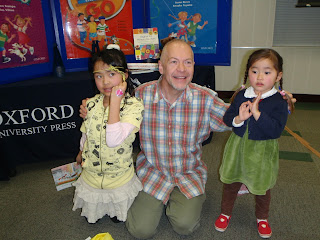
Kevin with OUP presentation helpers
In 1984 I saw a movie called Yellow Earth which made me interested in Asia and when I had the chance to teach in Japan in 1989 I took the opportunity and have been a language teacher ever since.
I have worked in language schools, big and small, public and private high schools and kindergartens, in 2006 I was a special needs teaching assistant in a UK primary school and I also write and present for the UK publisher Oxford University Press. One of my favourite series of books is the Oxford Reading Tree.
In 2005 I made a DVD published by OUP about teaching English to children in Japan.
From 1990-2004, I was an examiner for the United Nations Test of English Proficiency at their testing centers in Yokohama and Tokyo.  In 2009 I moved to Singapore and taught English to kindergarten, primary and high school students at the British Council and Hwa Chong International school.
I have traveled quite a lot in Asia and a little bit in Europe. I used to do a lot of sports especially swimming, squash and running but my main hobbies now are listening to music and reading. 
I also dj. My dj name is numonix and I play a kind of music called drum and bass. You can listen to this kind of music at www.humanelements.jp
Kevin Churchley.
Jim adds: Kevin will be presenting for Oxford University Press around the country in February and March next year, and will be adding a special date to the calendar in April - right here at Luna. Parents and teachers alike will want to see Kevin's very special classroom style and exciting ideas for involving young learners in their reading books. One of the major reasons we adopted OUP's The Story Tree series was because of the magic presentation I saw Kevin make years ago. I have known Kevin for several years, and I am delighted we have been able to tempt him back to his beloved Japan from Singapore. Please join me in welcoming him to our chilly town and to our warm school!

Friday, 6 August 2010

Sayaka returns - Canada's loss!

New podcast episode - Sayaka tells us about her Canadian high school & homestay

Sayaka joined my class when she was about three - she has just come back from High School in Canada. She changed a bit! Today, I got a little revenge back, asking her to help out with our current crop of nearly threes in pre-school. Into the bargain I grabbed fifteen minutes to ask about her experience living & studying in British Columbia over the last two years, while Tana held the fort (making bugs!)

I have always had a big soft spot for Saya-chan; I think you can hear the personality and warmth of the girl very easily in this podcast? She obviously enjoyed herself very much in Canada - I am sure ever so much more than she would have done through the drudgery of the local high school she attended her in town (I qualify to have an opinion - taught there!). She might not have been in school so much, but she sure learned an awful lot more about life & relationships, the world she is a citizen of.
 
Please listen to what she has to say* - she answers Patrick's question from Dublin, by the way - and please leave any comments below.

And pre-school? They loved her!
(*Podcast player now lives on the "Easy Listening" page - see tab at the top)
Enhanced by Zemanta

Wednesday, 4 August 2010

FAQs - High School & homestay in Canada

A satellite composite image of Canada.
What would YOU like to know about living in studying in Canada, as an overseas student? Thinking about sending your kids?

Now is your chance to find out - leave your question(s) as comments to this posting.

One of our ex-students is popping in to Luna on Friday to 'say hello' - she has just come back to Matsumoto after spending two tears in British Colombia, graduating high school last month. I will be interviewing her for a podcast, and will put your questions to her. Podcast will be published over the weekend - subscribe on the Easy Listening page (tab above) so you don't miss it!

I love it when our extended family come back as all grown-up friends!
Enhanced by Zemanta

Monday, 5 July 2010

Think smart - drink water

Jim-sensei was not at all sure how to start this class today!

He asked for some advice on Twitter, but maybe everyone was busy teaching too?! This is an annual problem though, as children are not hydrated properly in schools. In Australia, every child has a water bottle on them all the time, and are reminded to keep taking in liquids...here it seems almost an admission of weakness if you have a sip of H2O.

This affects a child's ability to concentrate/think, as well as actually being able to survive a very hot day without 'conking out'. We encourage our children in school to have a drink if they want - at first this is a culture shock itself!

Question remains - what would you do if your students were flat out asleep when you were due to start? 

(His classmates & I played a quiet game until he woke up & sleepily joined us.)
Enhanced by Zemanta

Monday, 7 December 2009

Matilda


Matilda is a little girl at the age of 5 who has an extraordinary intelligence and an amazing ability.

(There is a hint of her ability on the image of cover, can you find?)

The point I was interested in weren't only her amazing ability ,but also her character.


In fact, her situation isn't good.

Her parents aren't interested in her, they don't give her any books ,her school's principal is almost enemy among the students and she(principle) hates her.

Regardless of such a situation, she is very sensible and kind to her friend and her homeroom teacher too.


This is my opinion,I think such kind of ability doesn't effect on her mind good influent.

For example she may use it for making a trouble...

In this story she just used it for helping her classmate and her homeroom teacher from their enemy principle.

(Although Matilda used the ability once to her parents who were doing bad business for preparation of the battle toward the principle..)


Anyway,her amazing ability is great and exciting, but I don't know it's necessary on this story.

Because at first, I imagined Matilda would fight to the principle using only her courage and intelligence

and I thought it would be good experience for her in her life.

I think her nice character gave me a stronger impression than her amazing ability.

Reblog this post [with Zemanta]