Showing posts with label OUP. Show all posts

Tuesday, 25 August 2026

An imaginary entry in Anne of Green Gable's diary


Today was the happiest day of my life...so I thought. I was so excited to come to Green Gables. The road was lined with old apple trees. they were full of sweet-smelling and snowy-white flowers! The beautiful way made me feel like I were walking into a wonderful dream. I fell in love with this lovely place at once.

But everything changed so quickly. Matthew and Marilla wanted a boy, not a girl like me. What a horrible mistake! Why was I not born a boy? My heart was full of hopeness in this morning, but now, I feel so lonely and miserable.

What will happen to me tomorrow?Will they send me away?

Oh, Dear God, please! Please let me stay here. I promise I will work hard and be a good girl.

Posted for Nene


Monday, 10 August 2026

Let the kids talk!

Three videos here, highlighting how even very young learners can quickly become content creators in their English langauge learning journey! Each of these examples are a result of after reading projects, from graded readers, which all of our students at Luna invest in. We use these readers in a myriad of ways - not 'just' reading...we try to 'milk' them for all the're worth!

Misaki's Cake is the outcome from Oxford University Press' Read & Imagine graded reader called 'The Cake Machine'. Inventor Grandpa has a fairly calamitous baking experience...our children do better with a drawing project (homework) & then guided with a writing task in class to describe their lovely, dreamy, cake creations.

My approach as teacher is to do the background prep quickly, then let the students take control of the creative process, using the iPad + Chatterkids app intuitively. Recording themselves & criticising their own speaking (want to be smoother, or quicker, or not stop in the middle or get a word wrong...) is an easy fix - just re-record against the thirty-second limit. Their own pressure, not teacher's! As you can hear, the focus is on far more than just a list of ingredients - a proper description. As a quick finisher, Misaki was first - after that, she was first assistant & bling direction for whoever finished next. Teacher - job done (help the slower finishers with gentle suggestions & corrections).
 
What do you think of Misaki's cake?


A twist on this exercise I love with slightly older young learners, is to have them interview each other about their after reading projects. Here is Moe's description of her favourite animal (her real pet), from OUP's Read & Imagine title 'In the Treehouse'. Here the pressure is on both learners to ask, and answer, a set of questions quickly...so of course they want to practice a few times before hitting the record button - who said 'drilling' is boring?! Love Moe's "Wolfie"?


And from another class, Yuri & Koharu tackle the same task from their reader. 

Extensive reading has obvious benefits - so does intensive reading...the two do not need to be mutually exclusive. As you can hear, students are empowered with being able to share their imaginations and are unencumbered with stage fright, instead collaborating and being bold. Love these outcomes!


Saturday, 18 July 2026

Magic Ingredients! App-smashing with a reader

One app I really enjoy using with our graded readers as a boost to after reading projects, is to make sure that all of the students have taken time (and been shown how) to produce full, grammatically sound, sentences.

In this case, after reading OUP's Read & Imagine beginner level title The Cake Machine, easy homework was to draw their own 'dream' cake. The blank space below 'describe your cake' is a forbidding prospect without guidance...teachers job to ask leading questions, and then help everyone agree on their responses (all different, of course, but simliar in structure.

Obviously, most of the structures & vocabulary they need are high frequency from the book they've just read (and enjoyed) + the Picture Dictionary at the back a rich resource. "New words" (our own ingredients) an easy share on the whiteboard.

Bit of teacher speed needed to photo & crop drawing into the app, and then gave a example of 'how to' for early finishers, who get on with their project enhancement. Then they help the slower finishers through the tech hurdles and encourage the narrating part (they read their own writing into a 30 second limit). 


Sunday, 25 January 2026

No, I'm not fine!

"How are you? ""How are you."

Try again. "No. How are you?" "Oh. I'm fine."

How's he? 
And that's the end of the conversation for most Japanese students - get out of the conversation as quickly & as 'safely' as possible, with a generic response & no fuss. Certainly no extension, or attempt to broaden the scope - like enquire after the speaker's health. It's SO frustrating! Especially when I hear the inquirer react with "Oh good". Agghh!

So, I love unit 1 of Everybody Up 2, because we can break that mould. Here we meet 10 different emotions/feeling, none of them "fine" (which has lost all meaning). After this, require a 'proper' answer, every class, and a 'pass it on' reflex...either return the question, or turn to the next student as a round the room drill. Also, insist on different responses. And add a negative ( eg "I'm happy. I'm not sad."). Extension for bonus points in ay Cambridge speaking test!

Doing the same thing again...but it's a game?!
And sit down. Coats off (it's winter), rehydrate (in summer), blow noses (hayfever season)...

Teacher switches the grammar into a memory challenge; "How's Yuki?" Listening to other people? Becoming flexible with grammatical structures? "She's happy. She's not sad." 

And...every time, insist on meaningful, melodic intonation across utterances; prevent false starts/heads down...avoid 'speed of the slowest' answering as a group.

Mood meter
Personalise this - draw pictures into the back cover of the workbook is my favourite ploy. As a class, make a mood meter for the doorway (reminder, entrance routine etc).

Check spelling? In a way - but use the picture dictionary to start more extension.

Drill it to bits (pardon the pun) - another job for wordwall, again doing more with less. Embedding learning so it becomes a reflex, not an allergy!



Saturday, 24 January 2026

A joined up lesson - making the most of students' flashcards

Making a learning record with flashcards
I'm a firm believer of doing more with less - and a massive fan of good text books. Students need something familiar in the hands/bags, a structure they can grab onto and a bit of a routine they can enjoy diverting from...not glued to turning the next page at all, but able to thumb back through recognisable patterns, structres, chunks & lexical sets. And then have the confidence to be able to close the book, with learning internalised, push their English skills into deeper water with friends to help & to challenge.

Oxford Phonics World textbooks have a lovely set of flashcards tucked away at the back, which are a great resource to expand learning; introduce or review words (in this case CVC patterns), make sets or mix everything up! 
  • Teacher tip = have each student mark each of their cards with their own favourite colour (important these are different, so you can unmix easily when you play games etc) before cutting them out. And give each student a ziplock bag with their name on, to prevent losses!
Here we went at 16 recently studied words (shoert i and e sounds). Quiet time to cut carefully = also time to recall the pictures/sounds (which are on the reverse side). Many ways to review at this stage - teacher-led or students challenging each other etc. 

Matching & categorising: Wordwall
There's a 'blank' picture dictionary at the back of the classbook, which I love, because the artwork is the same, but it is in alphabetical order (not by unit)...a subliminal dictionary skill implanted! My approach with strong students = take a card, find it in the picture dictionary, and 'do your best' spelling it (after you've sounded it out) logically. Then check on the back & high fives, noticing a consistent pattern with the middle vowel sound/spelling. Students can do this together & correct/reinforce/referee each other (including comments on letter writing/legibility!) or competitively. Either way, teacher is passive but actively monitoring output carefully & encouraging constantly :)

Using wordwall as a follow up - I love this as there are so many different formats of game you can select per set of words (in this case). The thinking bit = different images, but clearly the same item. Creating these sets, you can add audio - male/female voice, lots of dialects to chose from. Be careful that you use a consistent sound that you want your students to model/mimic (US, Kiwi or Scottish ones that bend vowel sound? Or consonant sounds that disappear into glottal stops?!). You can have wordwall 'pronounce' all your cards, both sides, or just the one. Or none. Think about what you want your learners to do!


Wednesday, 8 September 2021

Arisa's after reading story :)

Pandasssssssssssssss!

 In the spring, Panda have a baby.

A small baby panda was born in China.

Tuesday, 9 March 2021

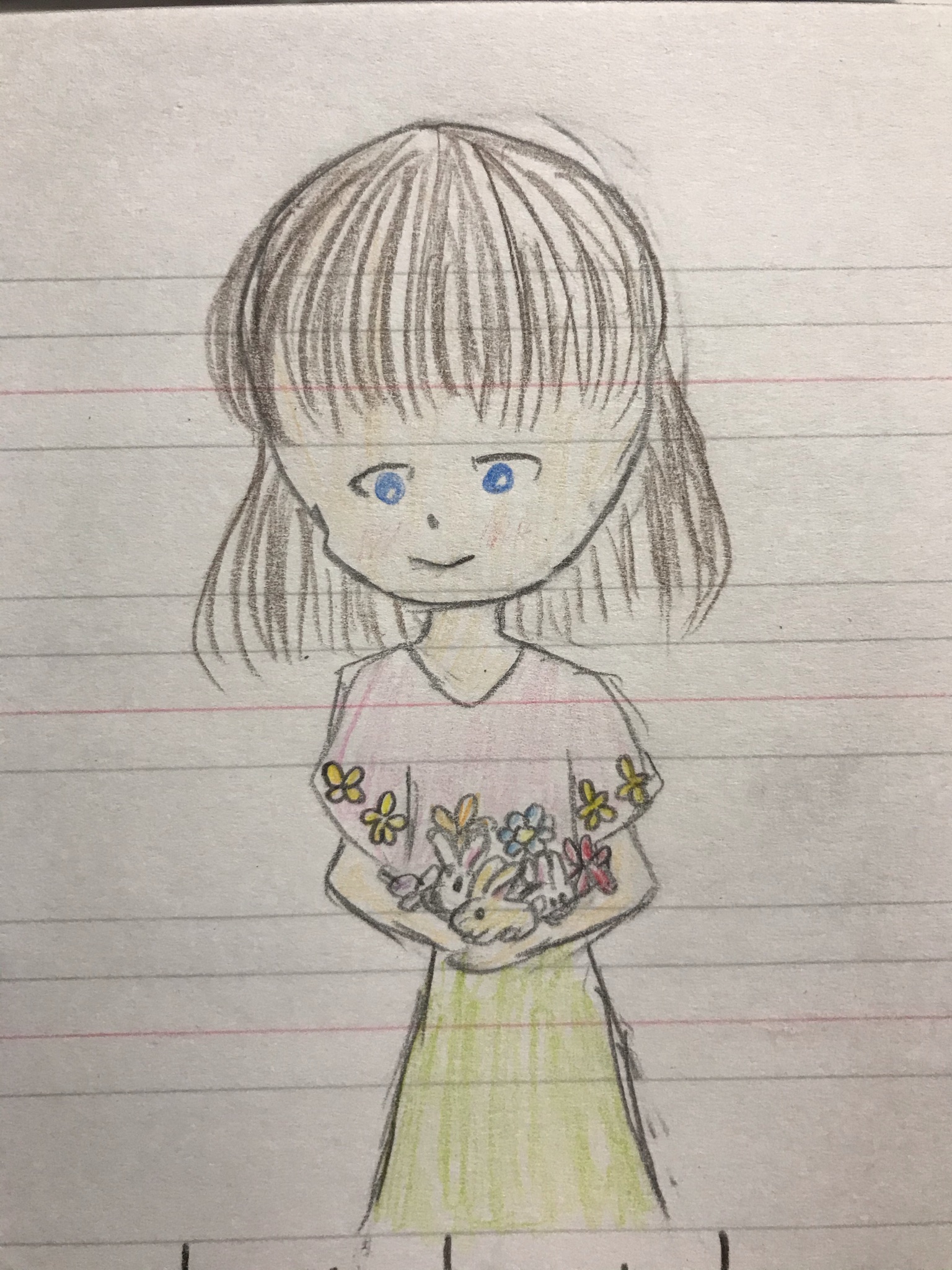
Nanaha's personification of Spring


Spring
After reading The Selfish Giant, by Oscar Wilde (OUP Dominoes graded reader version), a young reader imagines the character of Spring...think she came up with a fine piece of imaganiation (and writing, and picture!).

Spring has short brown hair and blue eyes. She is about twenty-five years old and she wears a pink t-shirt and a light green skirt.

I her hands she has lots of flowers and baby rabbits. She plants the seeds and brings showers.

She lives in a cherry blossom tree by the river.

She is very kind, cheerful, and friendly.

Monday, 28 September 2020

The End of the Phantom: Erik

After a long talk, Raoul and Christine took Erik with them to Norway. They built a large house beside a beautiful lake. Erik was a clever architect so he made their house nice and comfortable and kept their privacy quite well.

There was a small concert hall at their house and Christine sang her beautiful voice from time to time.

With her most generous and loving heart, Christine looked after Erik well, he had the happiest time of his life and passed away peacefully next year.

Raoul and Christine had three lovely daughters. They also had beautiful voices. The Raoul family became very popular for their musical talent, they were invited to the Opera house in Pairs. Their wonderful performance remained in the hearts of many Parisian and Parisienne for a long time.


Posted for Sayuri

Tuesday, 5 February 2019

Postcards from Scotland - After reading


Postcard 1

Hi, I am in Edinburgh of Scotland. I am visiting here to see “The Royal Edinburgh Military Tattoo” event near the castle of Edinburgh. Have you ever seen in TV etc that the people who put traditional kilt and play music instrument near the Edinburgh castle? I am exiting that I can see it soon!! I learned this time that the first performance conducted by the solders of Scotland and England to bring citizens back into good spirits after World War Two.

I am going to explore this city tomorrow. Let’s see together a lot of pictures taken in Edinburgh when I am back to Japan.

Postcard 2

Hi, I am walking to see Old and New Towns of Edinburgh. This area is very beautiful and I could see a lot of impressive architectures that blends the character of Old Town and New Town. There are many tourists because here was world heritage-listed area by UNESCO and I will see many tourists in fudge shop because fudge is famous as souvenir of Scotland. I will take some fudge to enjoy them with you with a cup of English tea.

I am going to visit the Isle of Skye tomorrow.

Postcard 3

Hi, I am in the Isle of Skye and this island was referred to “Skuy” (Isle of could/ misty isle). This isle is the northernmost of the major islands in the Inner Hebrides of Scotland and you can enjoy a lot of nature activities by walking, boat etc.

I am visiting Fairy Pools, and there are crystal clear blue pools. I have never seen such a clear pools and recommend you to visit here someday. You can see the beautiful pools like photo of this postcard actually. I think it is worth to travel long distance to see beautiful or impressive natures in the Isle of Skye.

I will be back to Japan and look forward to talking you about this journey with a lot of pictures.

Saturday, 15 December 2018

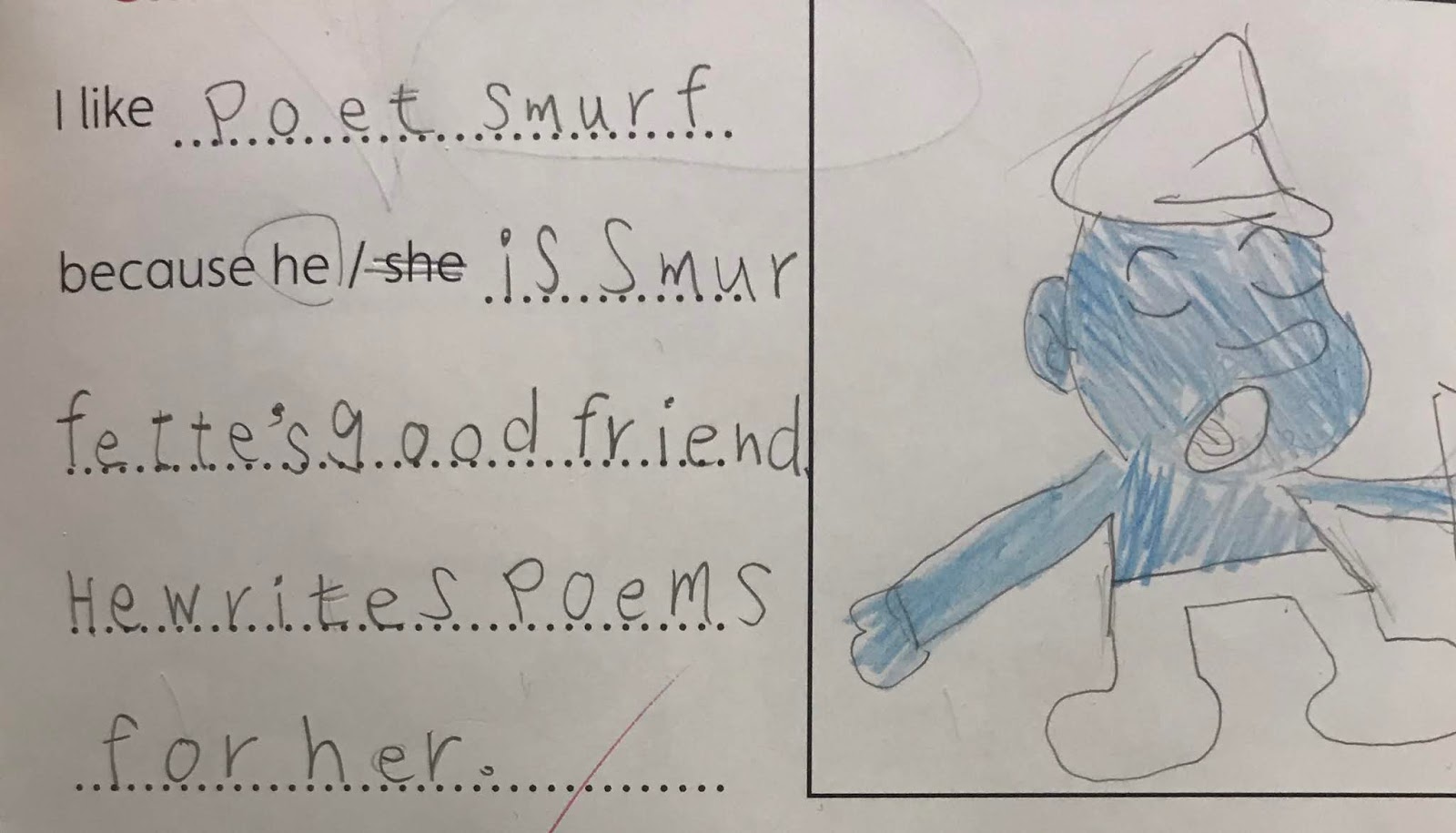
Who is your favourite Smurf?

Yuu's favourite Smurf
I like Papa Smurf because he is the leader.

He is very old.

He can make magic

Yuu K


Yuu's favourite Smurf
 I like Poet Smurf because he is Smurfette's
good friend.

He writes poems for her.

Yuu H
Moeka's favourite Smurf


I like Papa Smurf because he is the leader.

He is very old.

He can make magic.

Moeka


Kei's favourite Smurf
I Like Poet Smurf because he is Smurfette's good friend.

He writes poems for her.

Kei

Saturday, 29 September 2018

Black Beard - After Reading Treasure Map

Look at Kaito's treasure and follow his instructions to find the treasure. Will you be a great pirate and find the treasure chest?


Friday, 28 September 2018

Black Beard - After Reading Treasure Map

Look at Daiya's map and follow his instructions to find the treasure. Will you be a great pirate and find the treasure chest?


Friday, 30 June 2017

An invigilator share: Keys to writing examination failure

If you are taking an examination that requires you to write an extended piece of writing, then there are a few things you really shouldn't do. If you want to know what you should do to give yourself a fighting chance of success, then any good exam preparation textbook will give you a list of tips. My recommendation for success in FCE (Cambridge: First) would be a copy of First Result from OUP.

In no particular order, are ways to make sure you will not pass:


  • Bolt into the writing as soon as you are told to open the question paper & write furiously....good chance you did not read the question properly, certainly no planning or clear construction of an argument.
  • Rewrite everything - do it in pencil first then write over the top in pen....I have seen this done so often while invigilating I want to shout at the candidates! If you've got that much time, make a better plan.
  • Rubbing out your plan/notes....what's the big secret?! All question papers & rough work go in the shredder immediately after the test. And the table knocking on the wall while you do it?
  • Looking for extra questions....if you haven't prepared for the test then there's a good chance you've already wasted the entry fee. 
  • Reading & underlining the instructions...as above - you must know what you have to do, and have a solid battle plan before the day of the test
  • Writing two answers simultaneously....if you can do this then you should be in the circus. Concentrate on one task at a time. Recently saw a candidate write a whole paragraph in the middle of the wrong answer, realise the mistake, panic, copy it out word for word in the right answer (but wrong place) 
  • Go to sleep after blitzing the paper...are you really that good - there are no improvements you could make? Remove repetition maybe, improve vocabulary, elaborate or embellish maybe? At the very least, re-read critically. Inevitably, this is the candidate that did not make a plan.
  • Demonstrative body language while 'brainstorming' or thinking of a word...I'm not impressed, candidate - I don't do the marking!
  • Crossing out a full answer and doing another question....good luck with that against the clock.
  • Doing a Dostoevsky...the first question answered was such a masterpiece, the second one was no more than a post-script. Did you notice both questions were equally weighted? The marginal returns to scale are very limited if you go over
    your time allowance (ie 50%) and certainly counterproductive if you go over the word limit.
  • Counting...1,2,3...167... You should know how many words you can write on a line of A4 already! How many lines will you need to write to be within the target range? How fast can you write? Fine tune at the end when you've finished smoothly producing your work.
  • Leg-shaking...stop it. It annoys everybody.
  • Pencil-twirling...does that help you concentrate? Really?
  • Looking around a lot...relax, there's nobody sneaking up on you. Unless you are cheating, in which case I already caught you.
  • Checking your watch...we are on my time, the clock at the front of the room. It might not be 'right' but it is the one we are all using today.
  • Blanket on your knee...do you want to be disqualified? It's June and it's hot. The a/c will keep you awake at 24 degrees - you won't get frost-bite.
  • Using your favourite erasable pen...did you not read the instructions we sent you/that are posted on the door?
  • Shoehorning in all the must use phrases you could remember...appropriate? Relevant? 
  • I don't do paragraphs...which is a shame, because you just missed out on a load of marks
  • I usually write in the present tense...which makes telling a story kind of hard, and will likely put the reader to sleep. Pity, because the only person reading your work needs to be impressed with a variety & range of grammar & can only drink so much coffee while marking.
  • I just answered the question...so you didn't do all the other parts, like write a greeting, reason for writing, closing, ending? 
  • Plea for help...the marker really won't be swayed by begging. Nor will apologies get you anywhere.
  • Artist impression...this will work in Young Learners, perhaps, but very unlikely to be getting you any extra marks at this level. Pictures, emojis, lines joining ideas together, different colour pens? Not going to work.
Wow. That's a long list already! Obviously, Cambridge English does not mark candidates down, but rather employs a Can Do approach. However, if you set out to pass a writing paper and do any of the above, I guarantee you will not be scoring as highly as you could. 

So, exam candidates, please have another look at your teacher's or textbook's top tips, and use them. Plan. Prepare. Pineapple. Pen.


An IELTS (writing) examiner adds: " I don't invigilate exams but I sure do mark a lot of scriptsHey Candidate ! Know the exam you are going to take ! Not the name of the test but what is required to pass . I see a huge difference between candidates who have studied for their choice of test and those who wing it , as their university teachers cannot be arsed properly correcting their content , style or approach."


Friday, 29 January 2016

Fukuotoko - An unusual event in Japan.


As one of unusual celebratory event of Japanese New Year, I would bring up Fukuotoko-erabi. It is a religious event held at Nishinomiya shrine on January 10 every year. At this traditional event, approximately 250 runners make a fierce dash from the Omote Daimon, the entrance gate, for Honden, the main shrine hall as soon as the gate is open at 6 a.m. The first three runners who reach Honden are named Fukuotoko, the fortune men of the year. It is a great honor and, needless to say, a fortune to become a Fukuotoko. 

The runway has three curves and a slippery slope just before the goal, and these obstacles make the race result uncertain till the end. Every year this event is broadcast on TV news, and it shows many runners slide out at corners and the winner who is awarded a wooden statue of Ebisu deity for a good luck, sacred rice and sake. 


Monday, 23 March 2015

Goddess Athena in pt 2 of her TV interview

Athena continues to "blurt" about her ambitions with Hercules - a SockPuppet TV interview exclusive featuring Nanako!


An Interview with Goddess Athena - part one

As a follow up to reading about Hercules and his challenges, I wanted to know how The Goddess Athena felt about the hunk and his tormentor, King Eurytheus. I am sure you'll agree, Athena lives up to billing - in her own words!


Monday, 1 September 2014

After reading Rip Van Winkle...Nanako predicts 2034

Happy graded reader!
This is what I think I will see if I wake up after a 20-year sleep!

In people's houses...all the things have 3D screens, like your TV and computers. If you say "Lights on", the lights will come on.

In people's lives...you can go to work by a clean bus for free. People wear 3D shirts, and everybody prints their own clothes. You can decide the colour & design and everything on your computer. Life will be better.

In the way people work...some people work at home using their computers and the internet. People work more, because they do it at home - mums can work.

In what people do in their free-time...they can go to space for $1. People will play other new sports and you can do sports in the house with a special helmet. 

I would like to go the future now, cos. I want to see what I will be doing right now. I will not be married, and I will be a doctor in America and in Japan too.  My brother will be married, living in America and be a doctor too. My dad will be retired. My mum will be a normal mum, living in a small house in Matsumoto.

Nanako (7).

Can you do the vocabulary games on Quizlet for this story? Have a try!
http://quizlet.com/_roga1

Tuesday, 8 July 2014

Workshop No.3: Know Yourself, Know Your Students

Over June and July I have participated in the IIEEC-Oxford University Press Teacher Training Certificate Program in Tokyo run by Ritsuko Nakata. For each workshop attended their is an additional task of writing a report. Even though I am not intending to apply for the certificates, as I have no plans of attending all 6 workshops, I thought I would give them a go anyway. Any feedback or comments are very welcome.
Here is the first instalment of the workshop reports: Know Yourself, Know Your Students presented by Miki Sakai.

The focal point of this workshop was the “Multiple Intelligences” (also referred to as MIs, which is something I learnt about whilst completing my TEFL course), understanding the details of the different intelligences and how to apply them effectively within the classroom when teaching young learners. Everybody is said to possess each and every type of the 8 intelligences, albeit in different proportions. Unfortunately, especially in my case, just possessing these MIs does not necessarily make you intelligent. However by understanding the 8 intelligences, we are able to identify our students’ skillset to create appropriate lesson plans that coincide with their learning strengths by catering to their strongest intelligences. For example, a person who possesses strong “Math Logic” (or “Number and Reasoning Smart”) will be better suited to activities involving counting or logical thought, whereas someone who is “Bodily-Kinesthetic” (or “Body Smart”) is more geared towards activities which comprise of gestures and bodily movement. By combining as many of the intelligences as possible during our lessons, we are able to improve our students’ aptitudes for learning English.
It is interesting to note that each of the intelligences can be trained or developed, much like any other skill, meaning we can turn any weakness into strength. Or at the very least develop it to a point where it is no longer considered to be a weakness. The MIs also interact with each other, often in complex ways; they are not so black and white.  Students may be accomplished in many of the intelligences and may respond better to tasks that integrate various skillsets rather than focusing on them individually. People can be intelligent in many different ways and we can come to realize this fact through the MIs.
Even before attending this workshop I have always made a point of having variety in my classroom by trying new fun and invigorating activities as often as possible. Sure it’s great to have a little structure and routine as well, but as we all know young learners can be quick to lose interest in repetitive activities, which can lead to a dull and mundane classroom environment. Having attended the workshop, I now understand the importance of respecting my students’ proficiency in the different intelligences, not just the intelligences I am most comfortable and familiar with, in order to incorporate activities that focus on my students’ capabilities as well as providing flexible lesson plans that utilizes the MIs that the students are most skilled with whilst also developing their weaker intelligences.
Now comes the important part, applying what I have learnt from the workshop into my classroom. From previous experiences I have found that a majority of students tend to be visual learners, meaning that many of my classes include activities that revolve around the “Spatial” intelligence. I like to use props and items of realia as visual aids where possible in place of flashcards and promote associating gestures with words or phrases, even if some may not seem all that conventional. Students respond much better when presented with a visual stimulus when introducing new vocabulary, whilst the gestures can serve as prompts for when the students are unable to recall a word or phrase. I have also found that at times students are able to remember the gesture associated with the word instead of the word itself, although this doesn’t mean they have learnt and memorized the words completely I still view this as progress nonetheless.
Songs and chats are also a fantastic way of involving many of the MIs at once, it also gets the students motivated and energised whilst allowing them to express themselves with their bodies. There are such a multitude of songs to choose from it’s sometimes hard to decide what to use! I tend to go with songs that allow the students to express their individual creativity while interacting interpersonally with their peers. One of my favourite songs to perform is “5 little monkeys” from Knock Knock English. It combines the “Verbal Linguistic”, “Math Logic”,  “Bodily-Kinesthetic”, “Musical”, “Interpersonal” and (to a lesser extent) “Naturalist” intelligences in just 1 activity. There is even a video version available on the “Super Simple Songs” YouTube channel that would then additionally include the “Spatial” intelligence. This song also gives me the opportunity to work on my monkey impression, which always gets a great reaction from my students. Some of my students probably think it’s TOO realistic.

All in all I found this workshop constructive and beneficial towards my personal development as an English teacher, especially for young learners. As well as learning about the MIs in more detail than I had previously, the workshop gave me the opportunity to be exposed to new ideas and teaching techniques which I will be adding to my ever growing repertoire.

Thursday, 16 January 2014

Enunciate those important plosives, please, publishers!

Thursday is singing day - Jim's class in the afternoon really enjoys belting out a tune, even with almost no practice. Very quick ears and have a knack of coping with lyrics - the artwork in Everybody Up lends itself to this nicely.


For once I will be picky with Everybody Up as a text though, as I realised (the way the children copied) the audio is weak on something I think should be over emphasised - 'more oomph' was something I got laughed at for saying during my CELTA course way back when - that DON'T needs extra weight to convey the negative meaning of the utterance, and that the /t/ sound on the end of it is vital...instead there's a pretty lame "I donelai ........" which is meaningless. It might be construed as elegant ellision, but the message is hidden & therefore counter productive. OUP, you can do better on this one!

You can hear my guys putting a bit more gusto into their final plosives!

We ended up with a class invasion, as the next class arrived early and wanted to see what the fun was all about; we were missing our gate keeper Yukari downstairs (our son Ceilidh is unwell again). I was delighted the younger ones trumped their older mates in a game of I Spy - they started at the age of 2.5 with Luna and have been absorbing vocabulary voraciously ever since! No harm in letting students know that the competition is catching up quickly :)

Tuesday, 10 December 2013

Hime - how does your dog smell?

My dog's name is Hime. She is a small dog - a Cairn Terrier.She doesn't dig holes. She doesn't climb trees.She likes cats.

Hime is clean but smelly. She doesn't like baths or watch TV.She doesn't eat fish but she licks my face.

I love my dog.

Yuta (who made the picture using Dog Party iOS app by PBS Kids because he hates drawing!) talked/wrote about his own dog after reading an OUP X reader about a lazy boy called George (no relation) whose dog messed around in the background of the story.