Showing posts with label flipped classroom. Show all posts

Wednesday, 2 September 2026

Ignoring L1 in game play to extract English!


The background to this blizzard of interaction is that two of the students are new to the class, and originally a bit reluctant to speak up/take turns/be decisive (is scared of 'being wrong').

Aim of this game was to pre-teach the difference between singular & plural nouns - notice a) the right name of the animal...b) has it got an s on the end or not? Why/why not? I did not 'teach' this but rather, asked them to notice when it is used...form their own idea & check it out together - then remind each other as each image gave them two 'wrong' animal names, the others a 50/50 singular or plural option. 

Liverpool fan - "off side, ref!"
That the students used quite a lot of L1 while engaging in the game play = totally fine with me. It was
focussed, respectful and enabled them to 'manage' their participation in the game as teammates (encouraging each other to choose the correct answer/use the mouse) & competitors (throwing in bad advice!). What does annoy me enormously when I observe other classes is when L1 interferes with the progression of the activity - back channel to discuss other thiings, which indicates a lack of engagement/interest in the exercise...and/or the whole game is in L1 with next to no English input/output.

I also felt the children in this class were switching languages without thinking about it - really keen instead to get on with the game & win. That they didn't win = small beer; both teams scored loads of points and got most of the answers right - and they did all the hard work...teacher's job to notice 'glaring mistakes' (ignore mis-steps with the mouse or make light of jumping in too quickly & chosing the red-herring). 

This activity on Baamboozle not a filler at the end of class (the 'reward' or lack of a full lesson plan). Rather, previewing the next topic we are going to be dealing with in Everybody up Starter - essentially flipping the classroom & already drilling the vocab set (domestic/farm animals) & grammar point.

Win win.


Friday, 9 September 2022

Flipping word lists; young learners & Wordwall

Not a touch screen, but...
 My favourite page of any graded reader is the glossary, which in any good YL book is presented as a picture dictionary. These words are obviously important in a particular book for better comprehension, but might not be as high frequency as to pop up throughout a series regularly. Readers don't have to learn these words of course, but it certainly helps to be familiar with them/know where to look if they get 'stuck'!

Personally, I love to gamify such sets of vocabulary using wordwall, which has the easy option of adding any set to a Google classroom as a link or an assignment. We try to share everything we create at Luna as well...have a look & rate our stuff?!

YL blended class
Wordwall is a great way to flip a class/reader. Frontload all the 'hard learning' with a fun game or two (one set = 5 different ways (or more) to enjoy your creation without having to do any more creating at all (bingo busy teachers!)...if you have a PC screen for a class...collaborate, or take turns - whatever works for a particular class. 

And this can work for you with online learners - give a zoomer control of your mouse, and make the other students their 'helper' - warning, this can get noisy! Or the other way around, if your zoomer is limited by screen (tablet or mum's phone) then have them direct buddies with an open book, and have your in-class gang put books away. Put the team on the leaderboard...really does generate the need to go home & be the champion before next class :)

You'll notice, we haven't even started reading the book yet - but we want to now!

Lazy teacher! Directing traffic :)

Thursday, 11 November 2021

Games in the young learning environment - vital!

Picture-based vocabulary review
 As I keep reminding our teachers, if you have a good idea, see how much you can adapt it to fit other classes/situations. We do this a lot with Wordwall and Quizlet at Luna with online learners in group/collaborative work, which we also set as homework assignments for independent use. 

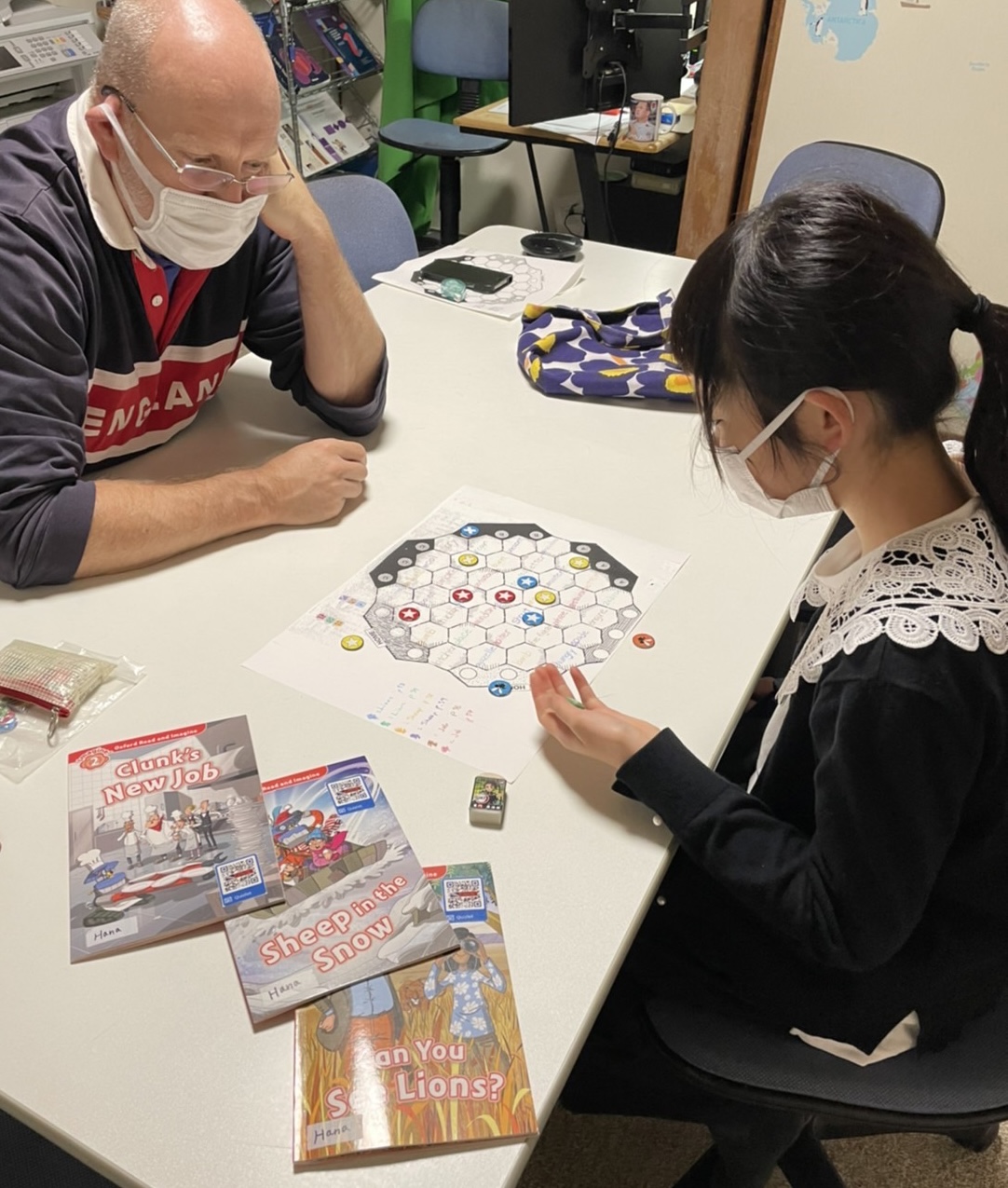
As described in a post last month, we wanted to get "hands on" for face-to-face young learners, now that we have relaxed the barrier requirements. (Of course, masks on, and all moving parts disinfected after use.)

Ideal game for groups x3
With first-time, younger players we paired up & helped each other out, sharing tips and tactics loudly! The board was colour-coded to make play more obvious, and laminated; memo, mount the photocopy on something stiffer to make it less vulnerable to nudges! Teacher's scissors & glue have been in the cupboard too long; nice to get creative again.

"Homework" last week was to take each of our personalised games out at home, and challenge family members. Distinct homefield advantage here, as each of the students made the games from vocabulary sets (glossaries) in the graded readers they have already read!

We can re-cycle these games in the coming months, as each students has a different version of the same content...which makes for ideal revision when we have 10-15 minutes up our sleeve at the end of a lesson or want to avoid getting into something 'new' just yet.

As a twist, Hana & I "flipped" our new
Hana head-to-head!
Read & Imagine readers
 by picking out words we were not sure about/wanted to learn and pronounce correctly before we got into them...smart girl still beat the teacher!

Another exciting pay-off was exploiting the word list at the back of the text book (Everybody Up in this case) for self-access revision; diving into dictionary skills and finding the 'hard' word in-context, and after searching for the same word three or four times, fixing it in memory for longer than usual!
Dictionary diving

To anyone who thinks 'games' have no place in the language learning environment, we think you are fundamentally wrong! Guess we'll have the proof of this little pudding when these Cambridge YLE takers sit down for A2:Key, B1:Preliminary & B2:First before they leave school in the years to come :)

(Adapted from a Mark Hancock pronunciation game)


Thursday, 1 July 2021

Flipping good work - young learners on Zoom

Two of my students moved away in the spring, but wanted to keep learning together as they've been with Luna/in the same class since they were knee-high. They have adapted to taking classes online really well, because they have confidence in each other, trust me (a bit!) and realise that 'mistakes' are just part & parcel of the learning process...but once upon a time a hair-trigger for tears & red faces. Now, giggles galore and superb collaborative English adventure.

Having adopted/upgraded to online presentation tools for textbooks, & digital copies of graded readers (kids still need physical books in their hands...reading is a tactile sport!) for our teachers to exploit, we've been re-skilling at Luna Towers on the job.

Last night, only one student could join me at the last minute...we've just started a new text book and I didn't want to leave her buddy behind or have to retrace our steps next week. We've just finished a set of readers and the new order is literally in the post. My game plan crashed & burned.

Sherlock Holmes:
The Dying Detective
Imagine MY delight when she bounced off her chair squeeling when I showed her the front covers of the new readers "I love Sherlock Holmes!" ... Let's run with that enthusiasm :)

Ceeding control of my keyboard & mouse, we worked together to build a Quizlet set from the glossary of 'harder' or less familiar words in the story. How? 

I have a fair idea her vocabulary 'store' so:

  • challenged her to spell 'known' or previously studied words (memory or a quick book dive) & then checking herself, by choosing an image (auto search is accurate enough) to suit. I liked this approach as her selections were different to mine!
  • familiar words I typed and she told me what she thought it meant (some L1 here), then image search to confirm understanding
  • obviously unknown & unique words to this story eg contagion or microbe, I added the word & found a suitable image & then checked for understanding ('corona?')
And there you go. Student generated content. Fully engaged both of us, and will be a great help to her buddy next week. Next mission with this set will be to make a copy, and have them both agree on a Japanese translation for the vocabulary. This will be a dictionaries open exercise if necessary, and another way we can flip our online classroom; after that game time in Quizlet and whatever else I can think of eg  wordwall or oodlu

The Quizlet set "Sherlock Holmes - The Dying Detective" OUP Dominoes "Quick Starter" graded reader produced by 'lunateacher' in our "Graded Reader - Young Learners" class. Feel free to join (it's free!) students and teachers!

Friday, 21 May 2021

Can't do my homework: Part 3 of 3 - flipped class

Activity from Primary Grammar Box (CUP)
Books closed, use it to hide a pair work activity and to lean on (one in-class learner paired with the Zoomer whose screen share also 'hidden' on another monitor). Pencils at the ready - no need to spell anything (although all the target vocabulary is familiar...didn't want to defeat the object of this exercise by getting bogged down again!) but the possible issue of artistic limitations/reluctance instead?

To be honest, I didn't monitor that output. Rather, I tried to see what the students were doing to get the language out...

  • glancing at the rods to 'get started' & 'load' the full utterance in their mind before starting
  • glancing at the rods to double check they'd 'used' each block/word ie completed their utterance (I wanted to make sure the time phrase was included to give meaning to the past simple target structure)
  • moving a rod to make sure they'd used the right word needed to add a couple of extra rods for the plural (doubled the ones in play) forms - nicely previews or flips next week's lesson
  • listening to each other better (for nitty gritty bits!)
...and of course listening to their spoken out & giving as much non-verbal encouragement as possible - which was not really necessary as they got on with the task really fluently, collaboratively and effectively. And, despite the masks, pretty chuffed smiles all round. And the dark clouds have lifted.

With that, I don't think any of us are dreading the next lesson! 

What are your solutions/suggestion/reactions? Let me know @oyajimbo on't twitter :)

Appendendum: a few days later I asked my son to get his homework book out (imagine the face!). I asked him to underline the words in the structure we'd been practicing with the same colours as we'd used midweek. Penny dropped - the colours had done the trick & he could correct his own work...

Where can you buy Cuisenaire Rods? 


Thursday, 20 May 2021

Can't do my homework: Part 2 of 3 - a different tack

Cuisenair Rods = colour + length 'coding'
I wanted to take the words out of the equation, but leave them in somehow. Replace them?

The Game Plan...and no, I couldn't remember exactly all the words either.

Solution...post-it notes. As a group, I asked them to write one word at a time on to a post-it (books open if needed); my online student did so into the Zoom chat. So no, not a 'spelling test' per se. Fortunately, my post-it notes were not very sticky so they needed weighing down (fan was on for a reason!).

Online? I'd opened a Google Jamboard & drawn colour lines where I wanted my student to enter text. Hard for newbies, but he's been learning on the job for a year now, and could cope with the challenge (enjoys messing about with the mouse/keyboard when I give him control, defacing things!). Problem = few colours available for the pen/type tools on Jamboard than I needed...

Unsticky post-it notes...just the excuse!
So we had the question form on the table, in a straight line, and then the answer below, so's that words 'lined up'. Putting the Cuisenaire Rods on the post-its = words were there but obsured, and could be peeped at if we needed a prompt (ie "I want to read the word")  without referring to the book. We negotiated block lengths to suit the actual words...subliminally giving each part of speech a different colour code into the bargain.

I didn't want to hide the words for my Zoomer, as he's already operating from the far end of the telescope and he has a lot fewer clues to work with - cannot pick up non-verbals etc. But, as his workspace was on another screen, my in-class gang did not realise he had an "advantage", so he became quasi-sensei & his ego was suitably enhanced.

Did it work? 

(Part 3 will be posted tomorrow)


Tuesday, 28 April 2020

Flipping boardgames for remote teaching - going on a safari!

Keeping it simple and familiar is a mantra I've been trying to apply as more & more of Luna's students are joining us remotely. There are enough 'new things' to have to learn on the hop right now, an overload of advice and a fair avalanche of problems usually at the last minute or as classes are starting/students arriving...

Animal Safari is a simple board game from Orchard Toys, which I like to use to reinforce learning of (low) numbers + animals, and the target language to differentiate singular/plurals...
  • "What can you see?" "I can see a parrot" or "I can see three alligators" etc
But how to play when the mice are all at home?!

Solution: looks messy (my end) but worked a treat for the end users, (9-10 y.o.) on iPhones.

Game set up on the floor, counters flat on the board. Bird's Eye view of the game & pieces by balancing an iPhone above it (plastic train track cellotaped to a box overhanging the table edge = avoids a shadow. Share that screen in Zoom, with your camera app open, making sure everything is "the right way up".

Floored - analog game play!
Teacher shakes dice for the students. Hold dice up to the iPhone camera so they can count for their turn. Teacher moves the relevant counter forward (make a note of player/colour counter in game play order!). If there is extra action eg take a card etc, then hold that card also up to the camera and let the game play happen - as much as possible get the participants to do all the talking (establish turns eg A plays, B asks the questions...B's turn, C asks the questions & so on).

Teacher meantime on video as Zoom host, giving feedback & correcting if necessary, keeping the action going & everyone involved. Not easy - juggling a number of roles! I got so confused I couldn't remember "Meerkat" when asked!

I think this set up will work with most simple & familiar board games out of the cupboard...going to try a few more! Avoids downloading apps and all the hassle there with extra screen time etc and also clearly not digital ie I, the teacher, need to be 'in the room' so I'm not going to making myself unemployed...

Give it a go - what analog game & set up works well with your YLE class?


Saturday, 4 July 2015

Sensei, I don't have a story to tell...speaker's block & interrogative teaching

Andy Offutt Irwin telling a story, Atlanta Bot...
(Photo credit: Wikipedia)
Casually mentioned I was trying to teach "The Narrative Tenses" last Thursday evening, via Swarm,  and then had a bit of a 'mare doing so. Friend, inspiration and twitter vivant +Michael @mickstout promptly asked me about resources to do so. Oh hell, called out!

Back story = used to employ a DELTA-qualified teacher whose every second sentence was about teaching the narra'ive tenses (Geordie), how good he was at it (them?) and that we should all d'off caps & bend a knee to the genius before us. But seeing as we have never had that many students in the rarefied reaches of advanced storytelling...you do need a bit for YLE Movers but you can generally get by without having to display any grasp of the past perfect simple/past perfect continuous/etc...in fact if you even tried, I think the speaking examiner would shake your hand!

This particular class week was missing the storytellers, instead only the 'answers on the next page already filled in' students had turned up. Any story telling they do attempt is in L1. My 'pardon?' usually gets a 'No, no' + dismissive hand wave. Been there? Can never introduce something stealthily or creatively because my thunder eternally stolen "that's on p45"...

Nuts & bolts of had + past participle etc all diligently underlined. But grasping the actual concept? Timelines, arrows, arm waving...Jim sensei needed to hit reset and start again.


So not only scratching my head all week about how to rescue the befuddled students from last week's grammatical cul de sac, needed to actually impress a colleague as well - or at least try to reply.

My students share the same language, and are not natural story tellers nor inquisitors. Imagine the opposite of Irish or Italian, maybe? Any contribution usually delivered as a set piece, accepted universally & scarcely a comment or question there be afterwards.

As usual, simplest is best, and decided after rummaging my collection of supplementary materials that nothing was really going to present itself. I needed to detox the class from the dreaded G terminology & translation mindset, and in some parlance flip the classroom. Keep books in bags, concentrate on imaginative brain, banish pencils, avoid turn-taking & prevent dominant personalities railroading others. Time too for me to be quite a lot more intrusive than I usually am (inviting fluency and letting 'errors' go).
A board game with out story telling limits

Solution. A narrative.

Dived into the back of our games cupboard & found Never Ending Stories (sorry, that awful song will start in your brains too!) - for age 6+ it says on the box. Ideal. Very simple. Totally random. Players plop cards onto a board in turn, and develop a story as suggested by the images on them (characters, objects, locations) in the order they have been played. Past tenses great. But the 'forgotten' past?

Start at the end of the story and add cards to try to get to the beginning, back-filling detail as you go. This is where the teacher needs to be very involved asking for connections, suggesting links, checking/requiring details eg Were they married before? What happened? How did they meet? and letting the whole group contribute - player whose turn it is selects 'best help' and adds the bits up. Importantly, before the next turn, teacher as narrator recaps - helping everyone keep up with developments and providing a model. Embellishment with current events etc as they occur to you are great, as students then get to see the rationale for the tenses you are using, without focusing on the tenses you are using per se - at least if the story is interesting! I challenge anyone to recount the same (and ever expanding) story the same way twice without leaving bits out; students need to see this is the beauty of storytelling not the mental linear blockage some see it as. Grammatical flexibility gets you over the hurdle and you can 'keep going' without having to go all the way back to the beginning of the timeline and get things 'in order' Students love pointing out the teacher's mistakes....ask them if you left something out...and 'rescue' yourself with a post script.
How our story unfolded - narrative to come

So, for me, interrupt like mad at the creative brainstorming phase, establish chronology and link bits together grammatically - then let that part of the story be told however it comes out. Once a turn is 'done'; gently re-tell it to check you got it right (include 'corrections' here?), and help the other students with a second listening before connecting all the other previous parts.

So there has to be a digital way to do this, for classes with wifi & tech savvy learners.Voicethread would be one way to collate a final version, I think, and could be done outside of class/before the next class. Sock Puppet, minus the time limit, another idea. Fotobabble only gives you 90 seconds - but ideal per pic?

In class, with confident students I think a Pecha Kucha type approach might work. You could also trawl ELTpics or any theme in Flickr - or go random and use flickr as a screensaver (hands free, adjust time images shown to suit skills).

Another randomiser = give a student a slip of paper with a ridiculous scenario on it and have them bluster their way out of it - kind of Liar's Game. (eg "You were seen climbing out of a nightclub window at 8am this morning wearing a superman suit")  Of course allow questions from the floor. Big class, have 2 or 3 students sit at the front and have them tell a story. Only one is true, room votes at end of story & Q/A on which one. NB They can all be false, but the winner = most convincing liar?!