
Showing posts with label exam preparation. Show all posts

Thursday, 11 November 2021

Games in the young learning environment - vital!

Picture-based vocabulary review
 As I keep reminding our teachers, if you have a good idea, see how much you can adapt it to fit other classes/situations. We do this a lot with Wordwall and Quizlet at Luna with online learners in group/collaborative work, which we also set as homework assignments for independent use. 

As described in a post last month, we wanted to get "hands on" for face-to-face young learners, now that we have relaxed the barrier requirements. (Of course, masks on, and all moving parts disinfected after use.)

Ideal game for groups x3
With first-time, younger players we paired up & helped each other out, sharing tips and tactics loudly! The board was colour-coded to make play more obvious, and laminated; memo, mount the photocopy on something stiffer to make it less vulnerable to nudges! Teacher's scissors & glue have been in the cupboard too long; nice to get creative again.

"Homework" last week was to take each of our personalised games out at home, and challenge family members. Distinct homefield advantage here, as each of the students made the games from vocabulary sets (glossaries) in the graded readers they have already read!

We can re-cycle these games in the coming months, as each students has a different version of the same content...which makes for ideal revision when we have 10-15 minutes up our sleeve at the end of a lesson or want to avoid getting into something 'new' just yet.

As a twist, Hana & I "flipped" our new
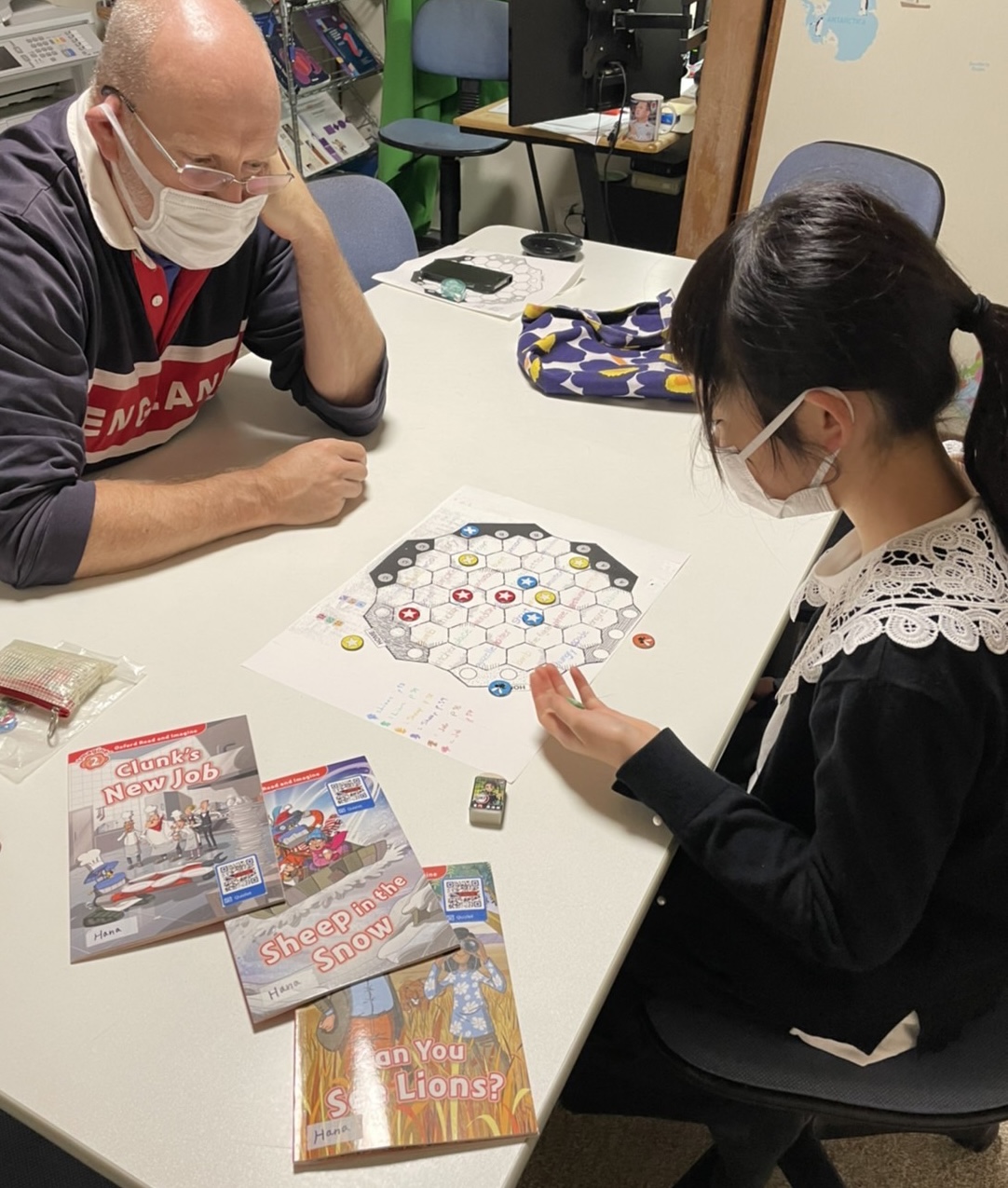
Hana head-to-head!
Read & Imagine readers
 by picking out words we were not sure about/wanted to learn and pronounce correctly before we got into them...smart girl still beat the teacher!

Another exciting pay-off was exploiting the word list at the back of the text book (Everybody Up in this case) for self-access revision; diving into dictionary skills and finding the 'hard' word in-context, and after searching for the same word three or four times, fixing it in memory for longer than usual!
Dictionary diving

To anyone who thinks 'games' have no place in the language learning environment, we think you are fundamentally wrong! Guess we'll have the proof of this little pudding when these Cambridge YLE takers sit down for A2:Key, B1:Preliminary & B2:First before they leave school in the years to come :)

(Adapted from a Mark Hancock pronunciation game)


Tuesday, 17 January 2017

Invisible writing - get those reluctant scribblers going

In September 2010, Peter Ross made a presentation at Shinshu JALT here in Matsumoto on Invisible Writing. It remains one of the most practical & helpful learning tips I have come across over the years of workshops & conferences I have attended. It is a technique I have occasionally deployed with my learners aiming for exam success.

Keep that plan handy - or you'll get lost!
A never-ending frustration with my learners - and I suspect a nationwide issue at least here in Japan - is how slowly ideas are formulated into words, and how slowly those words are organised/connected/embellished/collocated/contrasted/developed...brainstorming is not a concept familiar to very many students I have taught over the years, and certainly not as a communal effort after primary school age.

An observation as well, from hours and hours spent invigilating Cambridge exams, is how poorly (if at all) candidates plot out their writing. Time is critical in an examination especially, but skipping the thinking & planning stage is a massive mistake - which writing invisibly illustrates beautifully!

So let's assume we have focused on the writing task and identified:

  • The audience - who are we writing to and why? 
  • The format - is this a letter? an email? a memo? a report? an essay etc?
  • The voice - formal or informal? Contractions, abbreviations & emojis going to be suitable?
Let's also assume we have determined the time we have available for this - after the planning stage (please give that about 10 mins if you are at FCE level), and the target word count. Let's also assume we have written on A4 before & know approximately how many words we can get on a line so we know approximately how many lines we need to write (and not count every word back every two minutes?!)...

What stops writers even starting?
  • Blank paper panic
  • allergy to writing joined up ideas
  • lack of muscle memory - how often does anybody use a pen these days?
  • lack of confidence in vocabulary range, grammatical accuracy, spelling, my own voice
  • time stress
Familiarity with the task & a checklist of how the writing will be assessed helps enormously. Small steps first, and build on what you CAN do. Get those hands & brains trained!

What slows the writer down?
  • erasers
  • re-reading or editing on the go
  • re-thinking the plan
  • winging it
  • word counting
When you are planning or blitzing ideas, making a mess is part of the gig. Scribble everything down as it comes to mind & don't stop. Scrap paper is literally that - it goes in the shredder. Once you have blurted ideas onto paper, organise quickly with arrows & numbers. Add extra words or replace repetitions, order logically into paragraphs. Contemplate spelling at this stage & use another word if you are stuck - don't rub stuff out or compose fully fledged sentences.

So far, this invisible writing is kind of invisible! You will need a thin plastic 'wallet' for loose leaf papers, that a pen will be able to make an impression through, within which a sheet of carbon paper sandwiched between a sheet of lined paper (top) & a sheet of plain paper below. Make sure the carbon paper is the right way up. A pen that doesn't work - I prefer a pen the students will usually use (no not a pencil) or even the wrong end of a paint brush! The whole point is that the writer will not be able to see what they have written.

Can you see what we just wrote?
I promise this exercise will transform the way your writers will think about & approach writing tasks. As they are unable to see what they have done/are doing, the following tends to happen:
  • focus carefully on what they are actually doing & where they are on the paper, physically. This stops day-dreaming dead!
  • extra care in writing neatly
  • careful adherence & constant referral to the plan - get everything 'in'
  • maintain a flow (stopping to do anything else means you lose your place)
  • no editing or re-reading
  • erasers are out of the equation
  • writers 'see' their writing in their heads & concentrate hard to keep it there
When your writers have finished, ask them what they were doing. Let them identify what has changed in their writing process. One thing my writers never do - yours too? - is re-read their work afterwards critically. Invisible writers can't wait to review their work...spelling, missing punctuation, word order, grammar. You will never see your students keener, and you may even have to let them do a re-write (that precious second draft!) if they ask. 

I love invisible writing - does it work for you?


Monday, 13 October 2014

Who was to predict? Can you predict?

Active volcano Mount St. Helens shortly after ...
Active volcano Mount St. Helens shortly after the eruption of 18 May 1980 (Photo credit: Wikipedia)
On Saturday fine Autumn day, Natural disaster happened suddenly.
Why it was not rainy day?

It was very fine day, many climbers visited Mt,Ontake. They were enjoying the fall foliage. At the time suddenly Mt,Ontake erupted. They could not understand what had happened.

Many people had forgotten that Mt, Ontake is an active Volcano.
Over 50 climbers died. Is it cold have previson (prediction) of eruption?

Eruption prediction is very important for natural disaster.
I hope we will have foresee of danger soon.

Takeshi

Friday, 10 October 2014

Do you know Mount Ontake ?

English: Mount Ontake from Kuraiyama 日本語: 位山から...
Mount Ontake from Kuraiyama  (Photo credit: Wikipedia)
Mt. Ontake is an active volcano which is Japanese 100 famous mountains and is located at the prefectural border of Nagano and Gifu. Although it is a 3,000m class alp, it is relatively easy climbing and it is very popular in a broad generation. It is also known as a showplace of autumn leaves.

11:52 a.m September 27, 2014 steam explosion -type eruption took place for the first time in seven years. Since two or more factors increase damage, the death toll became the worst situation exceeding over 50 persons. It was Saturday and the weather is good from morning, large number of climbers were visiting from the distant place as well. Many people had concentrated near the summit of the mountain to have a lunch looking at magnificent view.

Help and rescue activities formed by the Nagano Prefectural Police and fire company as well as the Ground Self-Defense Force, run into difficulties because of a toxic gas and heavy rain caused by the typhoon.

Some events are cancelled under the influence of an eruption and the tourist is decreasing sharply, while damage does not reach the skiing area near Mt. Ontake. It usually passes, and preparation of commencement of business is advanced towards winter!

Posted for Saki