Showing posts with label Mark Hancock. Show all posts

Friday, 6 December 2024

Old fashioned, but it works!

I've always liked making materials for classes but kind of got out of the habit with so many digital resources to play with.

My number one preference with younger learners is Wordwall, as I can easily import class sets from Quizlet (been using that site for over 20 years) from resources previously compiled - be it text book lexical sets or glossaries from readers. The twist with Wordwall is that any images offered will not be the same as Quizlet = students do not just memorise the pictures. Once made, any one set can be used in a variety of different game options, and also be printed out as worksheets.

However, screen time can be overdone and younger learners need "hand time" as well - feels like something new & different.
Two halves of the 'gap fill'
To encourage question asking - and a follow up - as well as requiring students to actually listen to the reply and 'do something', this pair work exchange is easy to prepare and engaged students from start to finish. Target language was vocabulary items (classroom/school bag objects + colours)..."What is it?" (pointing at a blank square) then "What colour is it? Listener draws the item in the colour, and labels their picture (book open to spell OK if necessary). To fill up the grid I also added students' names = draw portraits of each other. 

Only 'banned' item = erasers, to stop this turning into an art class!

This worked one-on-one with "can do" kids...in teams when the group needed a bit of peer-support = added bonus of "your turn" etc classroom language.

Exercise complete
Students themselves decided to label their pictures, which was an added bonus to plenty of speaking/listening, with teacher gently making sure good intonation/full answers, and not too much time spent drawing (a relief to the less artistically gifted like me!)

This suited reviewing 2 units of vocaulary from OUP's Everybody Up 1
The second activity, to also review the same content...downloaded & printed the picture dictionary from https://elt.oup.com/student/everybodyup for the relevant units (Although from 3rd Ed, matches 2nd. Ed content)

Four-in-a-row template
Then a scissors & glue job (could also be a digital effort with excel I know, but this was quicker for me!) to fit onto a Mark Hancock game template of old. Can be played 1 v 1, or two teams; both worked equally well, and generated a lot of chatter. Quite a lot L1, but that was totally focussed to game play strategy/winning, with team mates (which was beyond my young learners in English)...whilst at the same time they were code-switching to read the vocabulary/name the pictures or ask each other "What is it?" & "What colour is it?"...because they really wanted to. When a drill is not a drill :)

Play? Roll the dice & choose a word from that box. Aim = 4-in-a-row. First past the post or fill the whole board, depending on time etc. Use - two different colour pencils. Use one board for each pair/team to share, or just one board to get passed backwards & forwards - I decided against this option as I realised half the class was always looking at the words upside-down.

Teacher? Sit back and enjoy the reading/speaking/writing magic :)

The template I made on the right - obviously colour needed for colours, but b/w will usually work nicely as the artwork is clear/matches the text book.
Game over!

The finished (yeah, messy!) Books open? If necessary...I prefer a sneaky peak only if "stuck". It worked out that teams helped each other or not very 'sotto voce' giving the game away if they knew the word first eg "Oh no, pencil!"

Easily replicated for any review a language teacher can think of!

Thursday, 11 November 2021

Games in the young learning environment - vital!

Picture-based vocabulary review
 As I keep reminding our teachers, if you have a good idea, see how much you can adapt it to fit other classes/situations. We do this a lot with Wordwall and Quizlet at Luna with online learners in group/collaborative work, which we also set as homework assignments for independent use. 

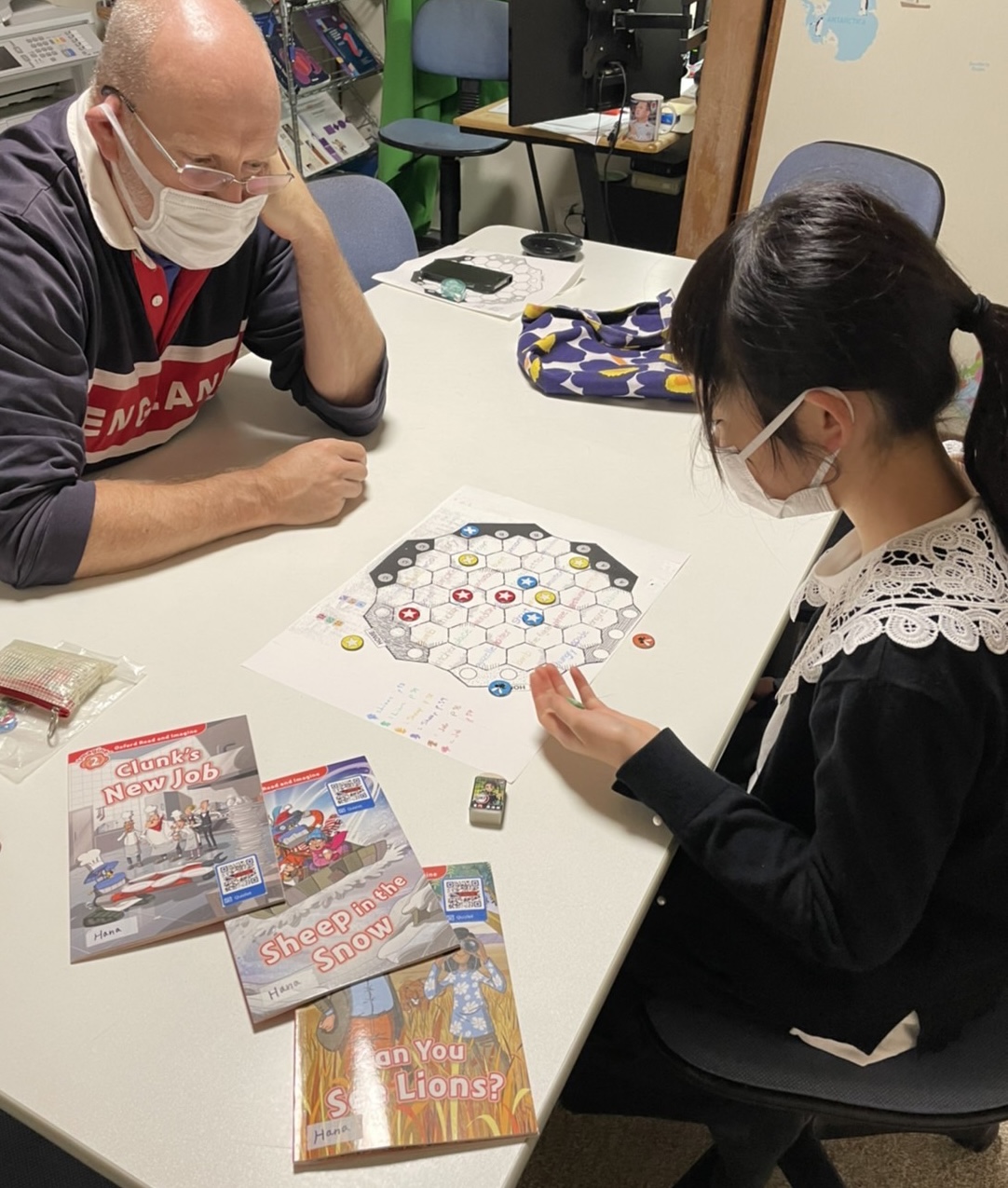
As described in a post last month, we wanted to get "hands on" for face-to-face young learners, now that we have relaxed the barrier requirements. (Of course, masks on, and all moving parts disinfected after use.)

Ideal game for groups x3
With first-time, younger players we paired up & helped each other out, sharing tips and tactics loudly! The board was colour-coded to make play more obvious, and laminated; memo, mount the photocopy on something stiffer to make it less vulnerable to nudges! Teacher's scissors & glue have been in the cupboard too long; nice to get creative again.

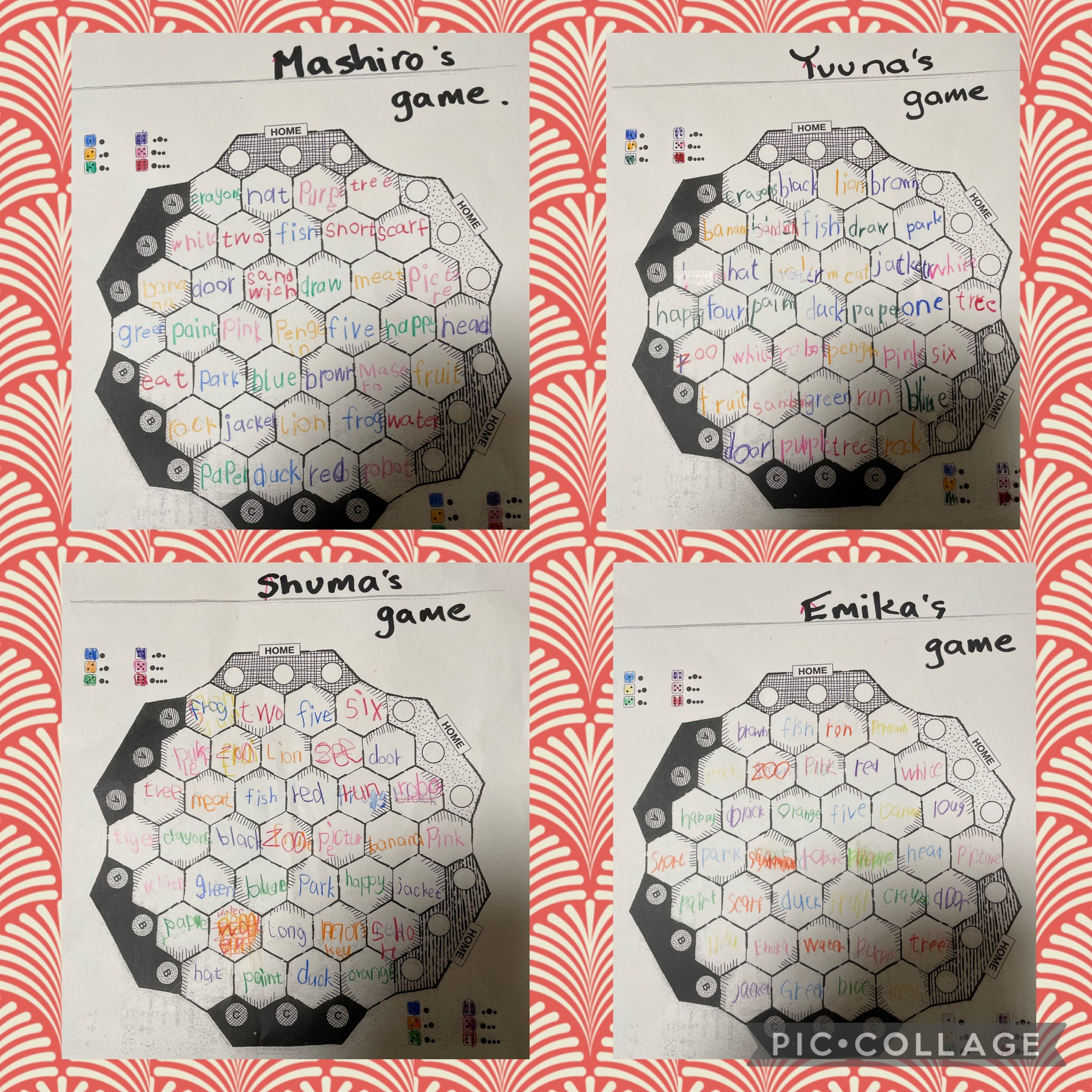
"Homework" last week was to take each of our personalised games out at home, and challenge family members. Distinct homefield advantage here, as each of the students made the games from vocabulary sets (glossaries) in the graded readers they have already read!

We can re-cycle these games in the coming months, as each students has a different version of the same content...which makes for ideal revision when we have 10-15 minutes up our sleeve at the end of a lesson or want to avoid getting into something 'new' just yet.

As a twist, Hana & I "flipped" our new
Hana head-to-head!
Read & Imagine readers
 by picking out words we were not sure about/wanted to learn and pronounce correctly before we got into them...smart girl still beat the teacher!

Another exciting pay-off was exploiting the word list at the back of the text book (Everybody Up in this case) for self-access revision; diving into dictionary skills and finding the 'hard' word in-context, and after searching for the same word three or four times, fixing it in memory for longer than usual!
Dictionary diving

To anyone who thinks 'games' have no place in the language learning environment, we think you are fundamentally wrong! Guess we'll have the proof of this little pudding when these Cambridge YLE takers sit down for A2:Key, B1:Preliminary & B2:First before they leave school in the years to come :)

(Adapted from a Mark Hancock pronunciation game)


Thursday, 28 October 2021

Boring glossaries...gamified!

DIY gamification
I've been wondering how to 'make more' out of the graded readers our younger students are enjoying reading, and in particular to exploit the target or new vocabulary.

I came across a tweet from @HancockMcDonald which reminded me of a favourite game I'd long forgotten - his Chinese Chequers pronunciation game. A quick little think and some eager readers with 'finished ' books handy, I asked them what their 'hardest' six words were, and to circle them with a colour pencil. Then I asked them to write their chosen words onto the blank game template, at random (importantly, not clustered together!), with that colour pencil. 

Then we looked at the second glossary page, and did the same thing with a different colour pencil. Another reader, two more pages & different colours, and a third book leaving us with seven blank spaces for the last group of words.

 As you can see, this became a very engaging activity and proved to have very valuable spelling practice built into it (which never hurts, and is always really hard to squeeze into a lesson plan!). Important to use pencils (not crayons) for ease of corrections (and fitting words into small spaces - I insisted on getting words 'on' one line).
The words I want to learn!


So why the six colours? It's a dice game...we will be exploring our own games next week, and then asking our young learners to challenge mum & dad at home for 'homework'! Stay tuned :)

Hope you like the idea - we did!